

If there were an aviation equivalent to a Catch-22 situation, then Long Island MacArthur, a secondary or reliever airport to La Guardia and JFK, struggled with it throughout much of its existence—namely, airlines were hesitant to provide service to it because of a lack of passengers and passengers were hesitant to use it because of a lack of service.
Origins and Early Service
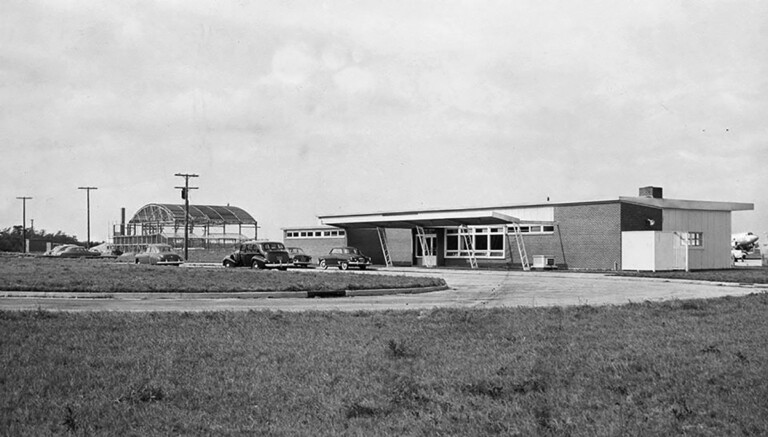
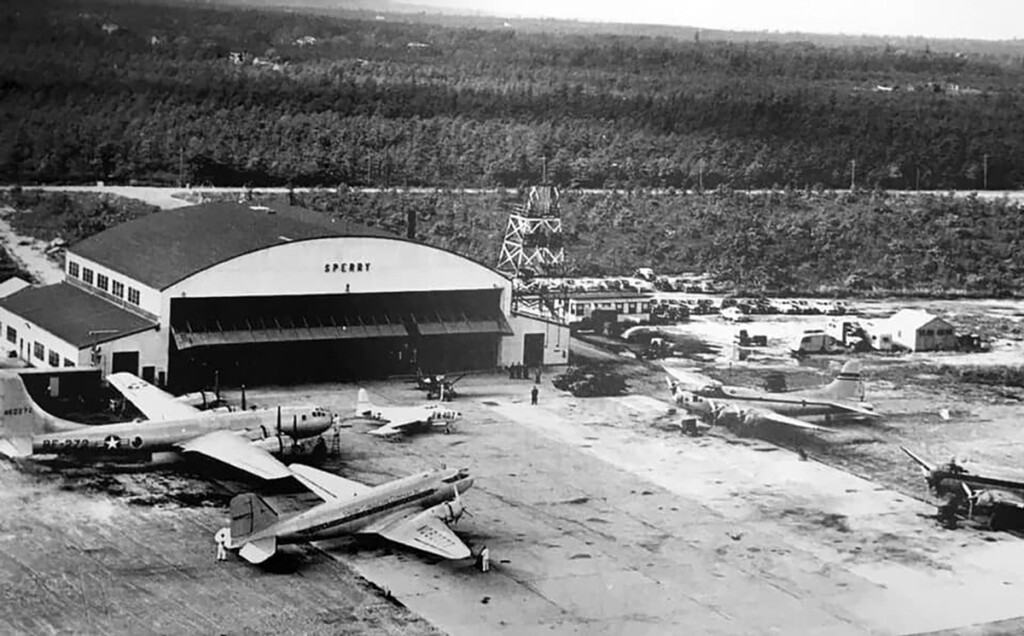
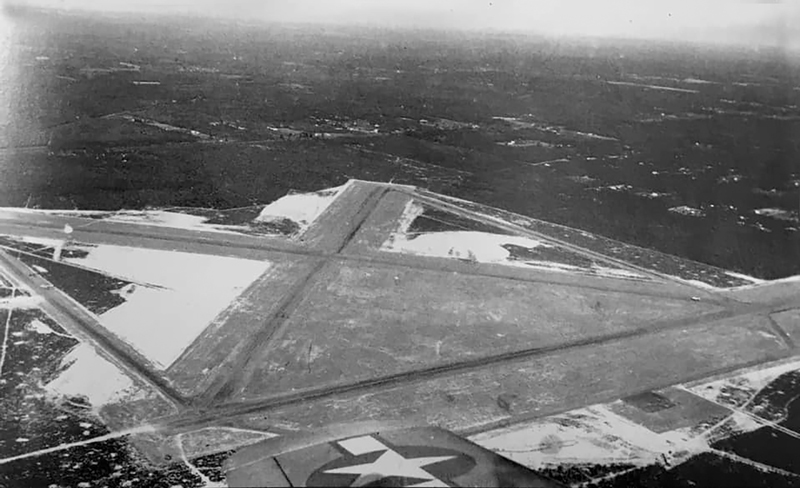
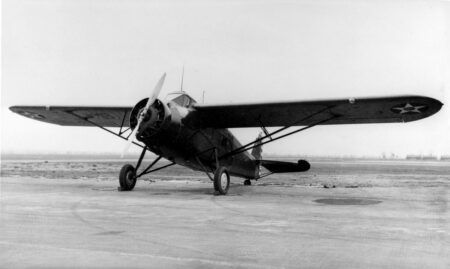
The result of Congress-appropriated funding for the Development of Landing Areas for National Defense, or “DLAND,” the Long Island airfield opened in 1943 under the simple name of “Islip Airport” in honor of General Douglas MacArthur.
Although a 5,000-square-foot passenger terminal and restaurant, funded by the federal government, attracted the short-lived scheduled service operated by Gateway Airlines to Boston, Newark, and Washington with de Havilland Dove and Heron aircraft, that offered by Allegheny Airlines in 1960 became more successful. It carried 19,000 passengers during its first full year of operation.
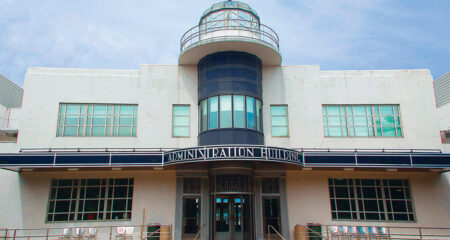
In 1966, a $1.3 million, 50,000-square-foot, oval-shaped terminal opened, sporting two opposing, ramp-accessing gates. So much did it reflect a hometown atmosphere that scenes from the original Out-of-Towners movie were filmed in it.
The notoriety of the eastern Long Island facility was achieved five years later, on April 26, when American Airlines inaugurated 727-100 Astrojet service to its Chicago-O’Hare hub, Islip’s first jet and trunk-carrier operation. Allegheny subsequently served Providence and Washington with its own jet DC-9-30s.
During most of the 1970s, its throughput averaged 225,000 annual passengers, and in 1978 it was renamed Long Island MacArthur Airport to reflect its regional location.
Catalyst to Growth
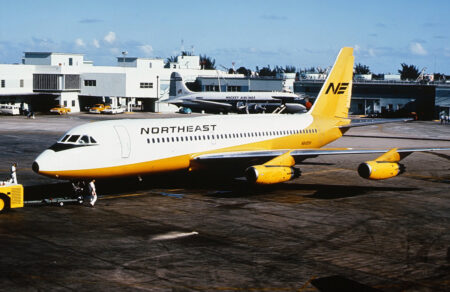
Market studies had long indicated the need for nonstop service between Long Island and Florida, and Northeastern International answered the call on February 11, 1982, when it began four-weekday roundtrips to Ft. Lauderdale and one to Orlando with a former Evergreen International DC-8-50. After acquiring a second aircraft, it recorded a 150,000-passenger total during its first year of operation.
By 1984, with Northeastern having served as the catalyst to carrier and route inaugurations, ten other airlines operated from it: Allegheny Commuter, American, Eastern, Empire, Henson, NewAir, Pilgrim, Ransome, United, and USAir, relieving JFK and La Guardia of traffic and fulfilling the airport’s originally envisioned role of becoming New York’s secondary facility. Two years later, it handled one million annual passengers for the first time in its history.
To cater to the increased demand, the town of Islip, owner and operator of the airfield, embarked on a progressive terminal facility improvement and expansion program.
By the end of 1990, the transformation of Long Island MacArthur from a small, hometown airport served by a handful of carriers to a larger facility served by many of the major ones was complete.
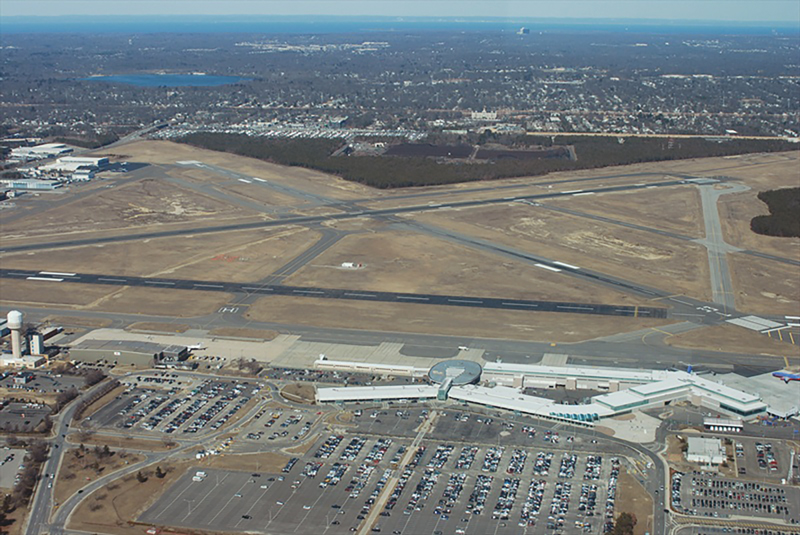
A $13.2 million expansion program of the 32-year old, multiply-renovated oval terminal, funded by passenger facility charge (PFC)-generated revenue, was initiated in the spring of 1998 and completed in August of the following year, resulting in a 62,000-square-foot area increase.
Key service inaugurations—particularly by American—in the 1970s and Northeastern in the 1980s—became catalysts to the airport’s recognition and often attracted other airlines and, ultimately, increased usage. The latest came on March 14, 1999, when Southwest began 12 daily Boeing 737 flights to Baltimore, Chicago-Midway, Nashville, and Tampa, with through or connecting service to 29 other destinations.
Despite consideration of other area airports, Long Island MacArthur was selected as its latest northeast destination because of the 1.6 million residents living within a 20-mile radius of the airport, local business health, and, according to Southwest Chief Executive Officer, Herb Kelleher, “underserved, overpriced air service” which was “ripe for competition.”
Following his initial, 1997 interest, then-Town of Islip Supervisor Peter McGowan and other officials flew to Dallas, where Kelleher stated the need for terminal and parking facility expansions before operations could begin. The meeting ended with nothing more than a symbolic handshake, but the 1999 inaugural flight proved the ultimate fruit that it bore.
By the end of the year, the airport recorded a 113-percent increase in passenger boardings, of which Southwest carried 34 percent alone.
After an increase to 22 daily departures, it self-financed most of a $42 million expansion of the East Concourse, increasing the current 19-gate total to 23, and for the first time MacArthur handled a sustained two million annual passengers. The originally-named 114,254-square-foot Peter J. McGowan Concourse officially opened in November of 2004.
Service Types
Throughout its eight-decade existence, Long Island MacArthur fielded four basic types of schedule service. The first was the turboprop commuter one to nearby northeast cities.
Pilgrim Airlines, for instance, made the short hop across Long Island Sound to New Haven and Groton, Connecticut, with de Havilland Canada Twin Otters, as did NewAir with Embraer EMB-110 Bandeirantes. National Air only flew a little further—in this case, to Newport, Rhode Island, with its CASA C-212 Aviocars—and Air Vermont routed a 15-passenger Beech 99 to Burlington via Hartford and Albany.
Like actors, many commuter carriers periodically and temporarily appeared on the MacArthur stage to collect passengers and transport them to northeastern destinations with an eye toward profitability. Many never achieved it. Examples of them included Mall Airways and Shuttle America.
Ransome Airlines came as close to establishing a mini-commuter hub there as possible, once operating 23 weekday departures with Mohawk M-298 and de Havilland Canada DHC-7-100 turboprops to Baltimore, Boston, Hartford, Newark, Philadelphia, and Providence.
Ransome itself, along with Business Express, CommutAir, Henson, and Precision, operated two-letter code-share flights on behalf of larger carriers, offering joint ticketing, boarding pass issuance, and baggage transfer under names such as Allegheny Commuter, the Delta Connection, and United Express.
The second major MacArthur service category was that operated by regional jets, which, because of their speed, could reach destinations further afield, but were also operated under code-share agreements, providing links to major airlines’ hubs and thus giving Long Island access to countless US and even international cities.
“Not only were the regional jets the most cost-efficient way for airlines to link hundreds of communities to airport hubs and global airline networks, these innovative aircraft enhanced the passenger travel experience and provided regional airlines with increased traffic, revenues, and greater market share,” according to Bombardier Aerospace, manufacturer of one of the types.
MacArthur operations encompassed those by the British Aerospace BAe-146-200 to Washington-Dulles with Presidential Airways/United Express; the Fokker F.28 Fellowship by Empire to Syracuse and Piedmont to Baltimore and Charlotte; the Bombardier CRJ-100, CRJ-200, and CRJ-700 by ASA Atlantic Southeast Airlines to Atlanta and Comair to Cincinnati, both operating as Delta Connection carriers; and the Embraer ERJ-145 by Express Jet/Continental Express to Cleveland and American Eagle to Chicago and Philadelphia.
Major carriers using mainline jet aircraft encompass the third major MacArthur service type. Examples of them include Allegheny/USAir, American, Continental, Eastern, Midway, New York Air, Pan Am, Piedmont, Southwest, and United.
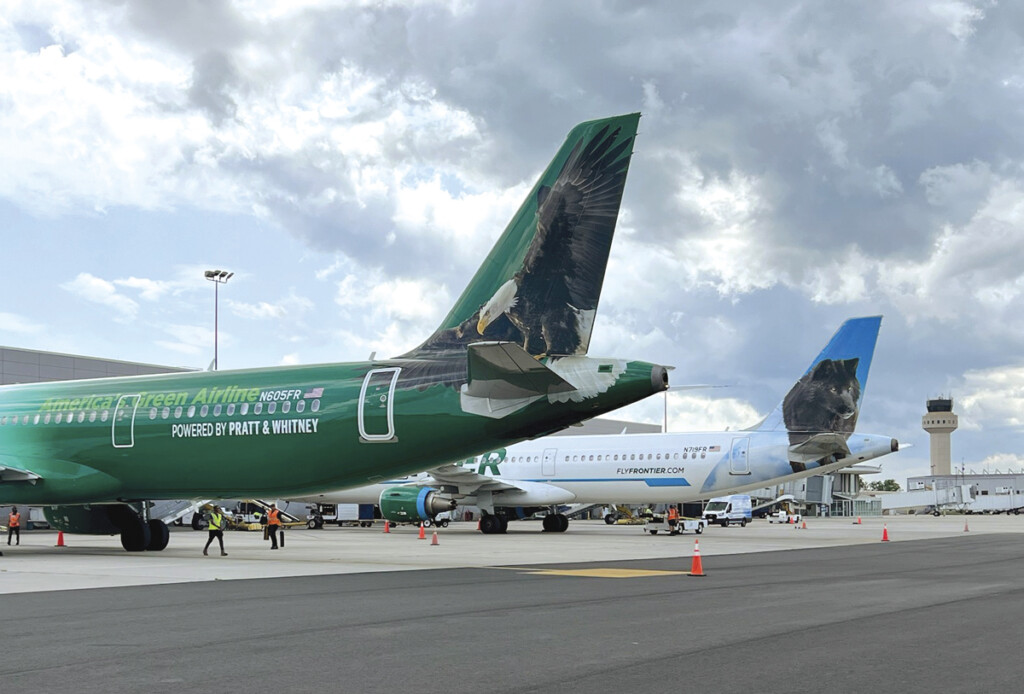
Finally, low-fare Florida service can be considered the fourth MacArthur category. Sparked, of course, by that of Northeastern, a long line of airlines followed in its footsteps—from Eastern to the third Braniff, Carnival, New York Air, AirTran, Delta Express, Spirit Airlines, Allegiant Air, Elite Airways, and Frontier. Although they served the expected destinations of Orlando, St. Petersburg, Tampa, Fort Myers, West Palm Bach, and Ft. Lauderdale, Allegiant Air and Elite respectively touched down in Florida’s own secondary airports of Punta Gorda and Melbourne.
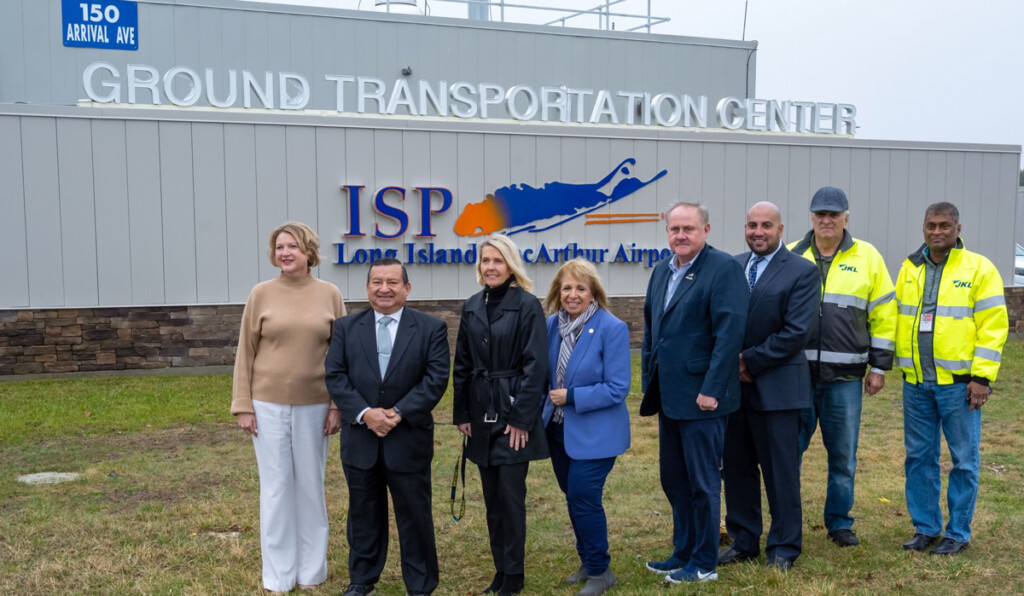
MacArthur Airport Today
The nature of Long Island MacArthur Airport’s operation has drastically changed. Other than Southwest, the major carriers have long since discontinued service there. Both turboprop commuter aircraft and regional jets became too expensive with which to make a profit. And airlines have redeployed airplane assets to markets where they could.
What remains is the new—and increasingly popular—breed of operators—the ultra-low-fare ones like Breeze Airways and Frontier with less-than-daily and sometimes seasonal-only service, predominantly to Florida. Although passengers have consistently extolled the virtues of the airport’s convenience and hassle-free travel experience, Long Island MacArthur has, in many ways, returned to its Catch-22 situation: passengers seek service to destinations other than Florida, while airlines cannot profitably operate to them.


4 Comments
It’s always been my preferred airport to fly to when I visit family on Long Island. Can’t stand La Guardia as the only link to mass transit is a bus despite the billions they spent on the terminal. JFK is better at least you can jump right on the air train & connect to mass transit. But I still would rather go to ISP car rental is easy & traffic is not bad. FLY NAVY!!!
I could not agree with you more. I have been interested in the history and development of Long Island MacArthur Airport, which can be considered a secondary or reliever facility to JFK and La Guardia, for decades and have, in fact, written numerous articles about it. It does have a way to go, however, to get back to the variety of service that was once offered there. Now it principally concentrates on Florida destinations.
I’m trying to find a photo of the control tower that stood in the late 1950s. My father used to take me to watch the planes take off and land. I swear there were stairs to the roof that we used to climb.
You may try the Lake Ronkonkoma Historical Society for vintage photographs of Long Island MacArthur Airport.