

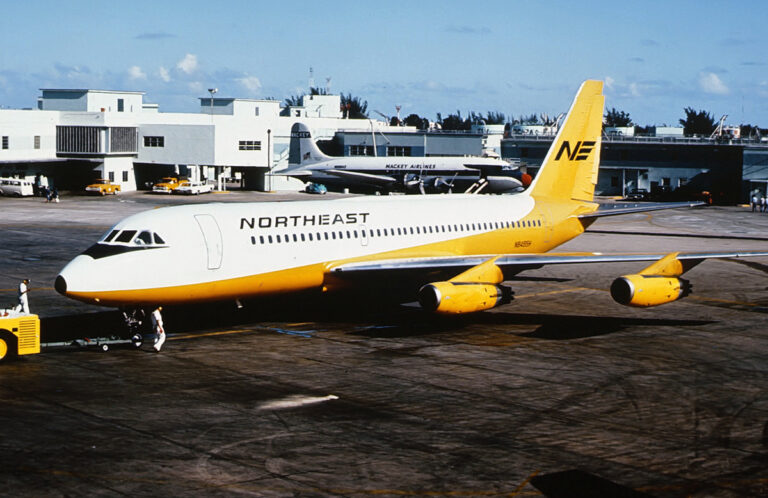
From often-snowbound New England to sunny Florida, Northeast Airlines, forever associated with its “Yellowbird” aircraft, chartered a checkered course that entailed financial lifelines, a dual-sided personality, and major carrier competition. Its route system, pieced together by Civil Aeronautics Board approvals, became an elusive attempt to establish an identity and profitability.
From Railways to Airways
As the 1930s dawned, surface travel was mostly achieved by rail, with few bona fide airlines and rudimentary, open-cockpit biplanes transporting mail and the occasional brave soul. But Maine Central Railroad, seeking to extend its service from tracks to the air, formed Boston-Maine Airways in July of 1931 for just such a purpose, operating under contract to Pan American Airways. Yet the experiment, spanning the two-month period from August 1 to September 30, ceased after one of Pan Am’s Sikorsky S-41B flying boats crashed into Massachusetts Bay three days earlier.
Second Attempt
Two years later, a second Boston and Maine Railroad subsidiary, still named Boston-Maine Airways, achieved greater longevity and success.
“The carrier’s early fights were operated under contract to National Airways, whose founders included Paul Collins, one of the country’s first airmail pilots; Samuel J. Solomon, a pioneer airport operator; Eugene Vidal, a West Point graduate; and Amelia Earhart, the first woman to fly solo across the Atlantic,” according to the Delta Flight Museum. Famous aviatrix Jacqueline Cochran later served on the board of directors.
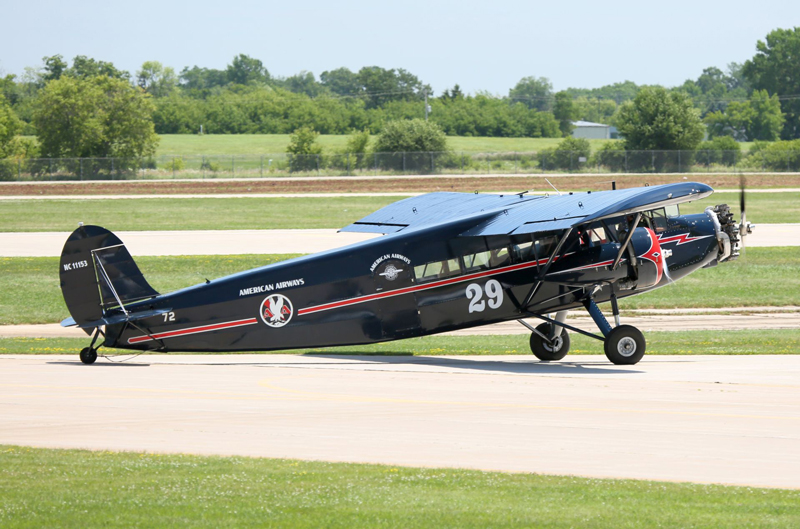
Its initial fleet, a pair of eight-passenger, 120-mph, fabric-covered, high-wing Stinson T SM-6000 trimotors, enabled it to inaugurate scheduled service on a Boston-Portland-Bangor route under the command of Captain Milton H. Anderson.
By 1937, when Boston and Maine purchased National Airways’ assets, including its airmail contract, it had already taken delivery of what would become the mainstay of its early fleet—the ten-passenger, all-metal, low-wing, twin-engine, 160-mph Lockheed L-10A Electra.
Early Expansion
Although World War II thwarted the carrier’s peacetime operations, 1940 marked a milestone in its history when, in November, it was redesignated with the more geographically appropriate “Northeast Airlines” name.
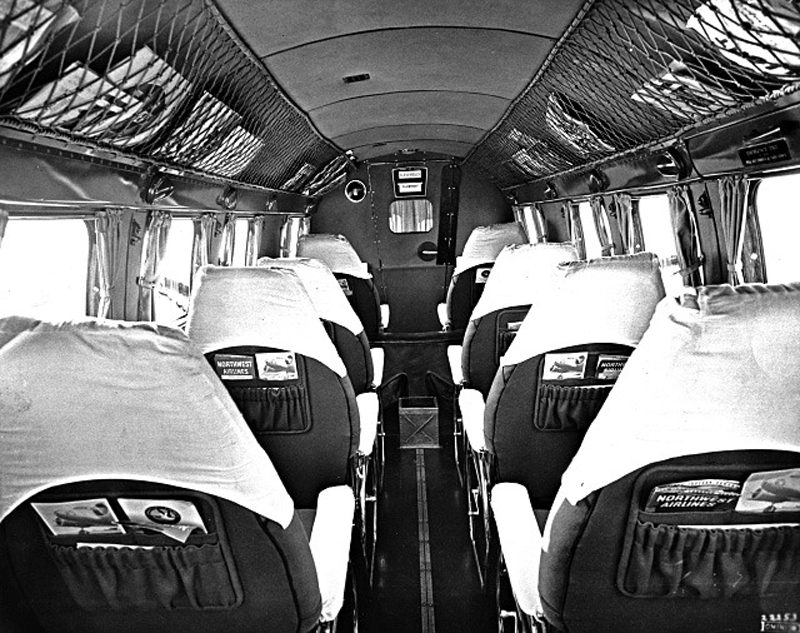
It had also begun to replace its Lockheed Electras with wider, higher-capacity, 24-seat Douglas DC-3s, which it advertised as “24-Passenger Douglas Liners,” explaining, “The interiors of Northeast’s new, 24-passenger Douglas transports are restfully decorated. Reclining seats with ample room add to the comfort of New England’s most up-to-date air travel.”
Part of its expansion came with the acquisition of other, admittedly tiny carriers.
“Through mergers and route awards, Northeast rapidly expanded in the post-war period,” advises the Delta Flight Museum. “In July 1944, it took over a route from Newark, New Jersey, to Springfield, Massachusetts, previously operated by Airline Feeder System. In August 1944, it acquired small Mayflower Airlines and began service to Cape Cod, Nantucket, and Martha’s Vineyard.”
Billing itself as “the wings of New England,” it offered hourly flights, from 07:00 to 24:00, with 60-passenger Douglas DC-4 Skymasters, “the largest passenger planes in present-day service,” it emphasized.
Moving up in the Ranks
Northeast slowly shed its small, local service carrier image by implementing large-airline strategies.
Although its “Yankee fleet” served New York, Montreal, and 34 destinations in New England with its DC-3s and CV-240s by 1951, it began to emerge as a more serious, major airline contender as the decade progressed.
In September of 1956, for instance, the CAB gave it temporary authorization to serve the Sunshine State, ending the twelve-year Eastern and National duopoly. Aside from its newfound prestige, it gave the carrier several advantages.
- It gave it Florida vacation associations to would-be passengers.
- It became a logical, southerly extension of its northeast route system, providing important feed at New York-Idlewild.
- It gave it its first “long-range” route, reducing its average systemwide operating cost per sector mile.
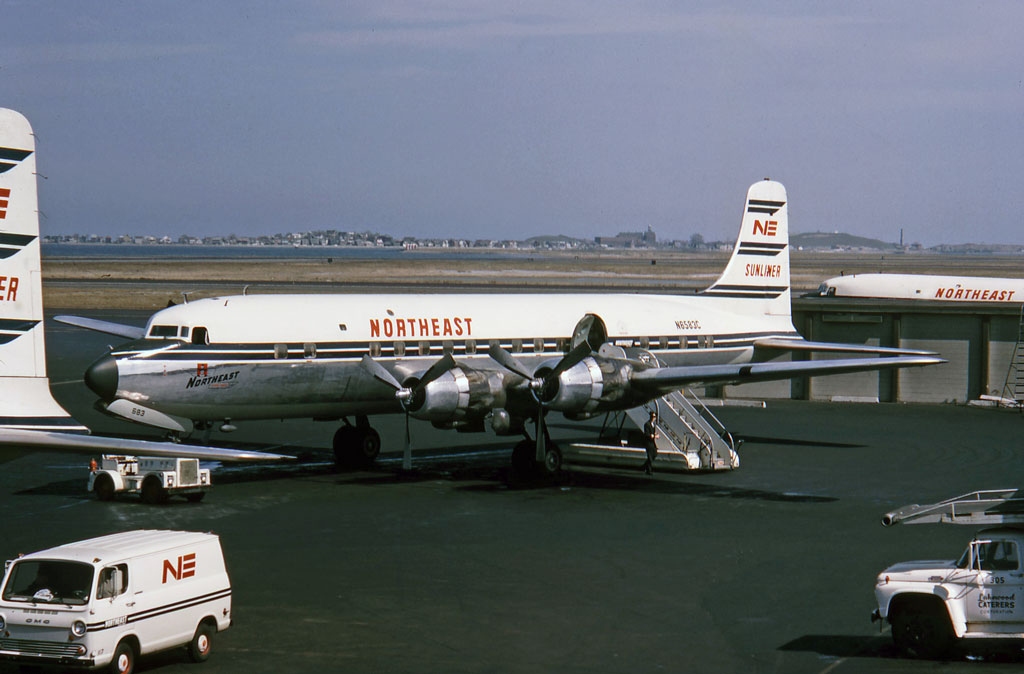
For the new route and others, it purchased 76-seat Douglas DC-6Bs.
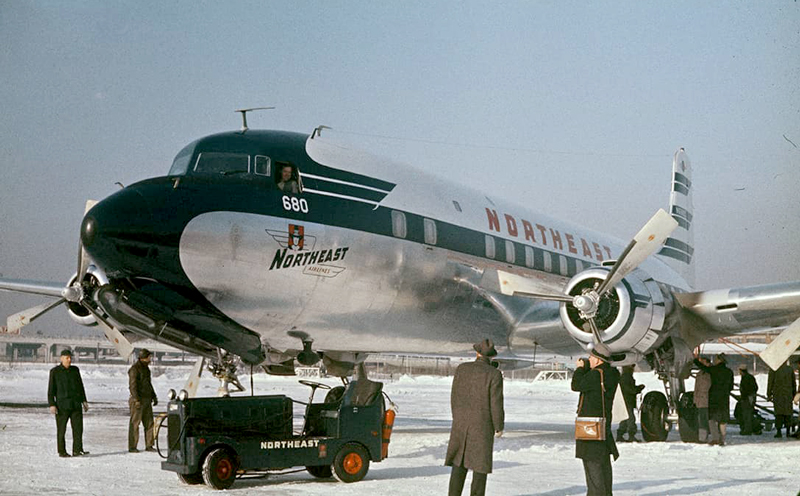
“Ten new DC-6Bs will soon be offering sky-high luxury throughout New England and to New York and Montreal,” it advertised.
Serving 45 destinations in New England, the carrier now operates from both LaGuardia (Gate 11) and Idlewild airports, the latter the exclusive domain of its Florida Sunliner flights.
Fleet Additions
Northeast continued to introduce new and faster equipment.
In 1958, for example, it became the third US airline, after Capital and Continental, to operate the Vickers Viscount turboprop produced in the UK, taking delivery of two specifically-ordered V.798Ds and eight V.745Ds intended for financially-failing Capital itself. Placed into service on its higher-demand New England and Florida routes, the type further helped it shed its local service carrier image, increasing its market share. During the first half of 1963, in fact, load factors exceeded 60 percent.
Its first permanent, pure-jet type (after leasing a TWA 707), however, took form as the high-speed, quad-engine Convair 880, which it toted on the cover of its June 24, 1960, timetable with the enticement, “Fly the Convair 880 jet, the world’s fastest jetliner.”
Featuring an internal configuration of 32 first class and 65 economy seats, it was inaugurated into service on the Boston-Philadelphia-Miami route on December 15.
“The jet age was a wild roller coaster ride of highs and lows for Northeast,” the Delta Flight Museum states.
Advertising the “most jets to Florida” on the cover of its April 30, 1961 timetable, it routed its Convair 880s from Montreal through Boston, New York-Idlewild, Philadelphia, Baltimore, Jacksonville, Tampa, Ft. Lauderdale, and Miami, although flights operated various portions of this flow.
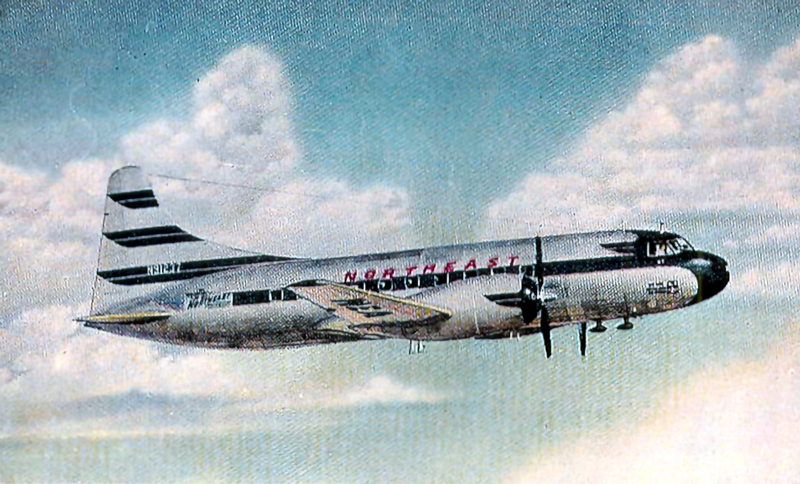
Despite the advancement, the Northeast almost took a step back.
“During 1963…Northeast again went to war, this time against the CAB, which decided by a close vote that the Florida market did not require a third carrier and instructed Northeast to end its Florida service,” according to “A Pictorial History of Northeast Airlines: 1933-1972.” “The flood of mail, calls, and telegrams turned the tide, and in 1965, the company-wide effort ended in victory and a permanent certificate to fly the Florida route (was issued).”
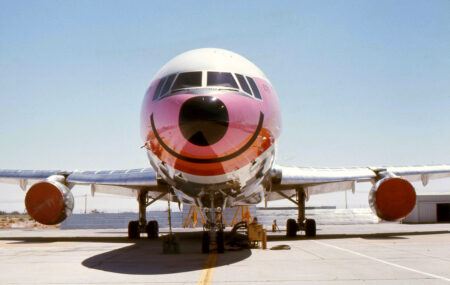
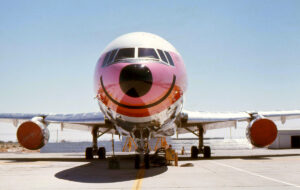
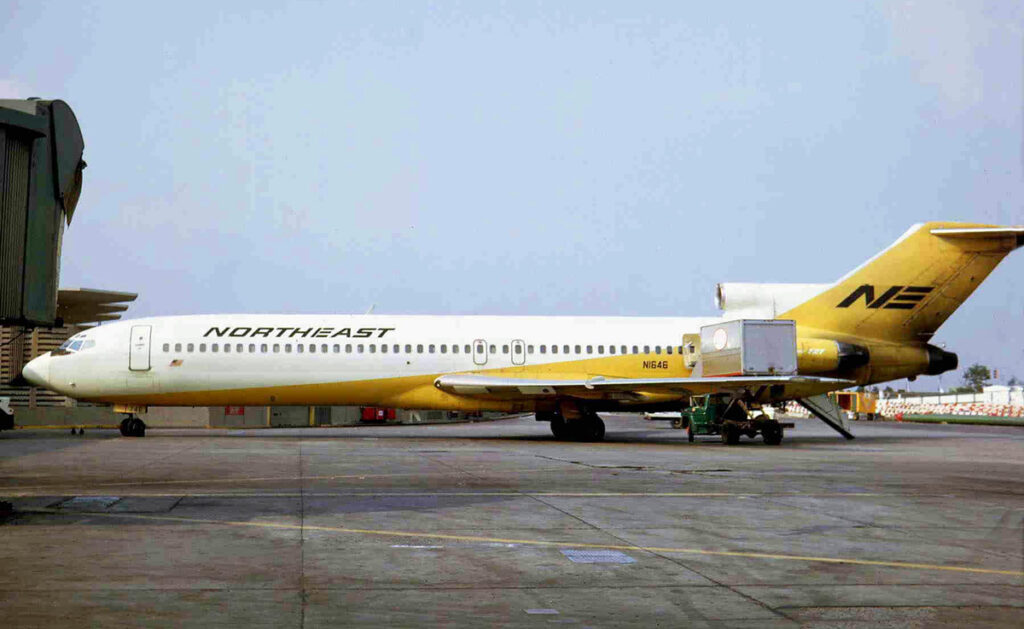
Injected with desperately needed funding, the carrier was purchased by the Storer Broadcasting Company, which rejuvenated its image with its once-famous Yellowbird campaign.
“Possibly the most successful of the new paint schemes was Northeast’s Yellowbird look,” advises R. E. G. Davies in Airlines of the United States Since 1914. (Smithsonian Institution Press, 1998, p. 571). “Conceived by the famous industrial designer, Raymond Loewy, Northeast employed a color never previously used, and its dramatic impact helped considerably to demonstrate that its sphere of interest had developed beyond the sheltered confines of the colonial northeast.”
The carrier stressed its new image by advertising, “Catch a Yellowbird and let luxury happen to you” and “In every Yellowbird, there beats the heart of an eagle.”
“Yellowbirds, each with a proud sweep of sunshine yellow from nose to tail, are the gleaming symbol of a brand-new airline,” it proclaimed.
Promise, not Profit
Northeast continued to expand while its cash continued to contract.
In 1968, for instance, it inaugurated service to the Bahamas, and Bermuda followed in 1969. It was also granted transcontinental route authority from Miami to Los Angeles.
By the middle of the decade, it began another fleet modernization program, taking delivery of the 96-passener 727-100; the 44-seat Fairchild-Hiller FH-227 turboprop for New England regional routes; the 92-seat McDonnell-Douglas DC-9-30 in 1967 for operation to Cleveland and Detroit in the Midwest, as well as within its established northeast, Florida, Bermuda, and Bahamas network; and the stretched 727-200, qualifying it as the first to operate the higher-capacity version when it placed it in service on December 14, 1967. It essentially replaced the Convair 880s.
The northeast-to-Florida routes had offered great promise, but not a great number of passengers.
“(The routes served as) good examples of how the public benefits of competition are normally achieved by the rival efforts of two—and no more than two—operators on the same route,” Davies wrote (ibid, p. 344).
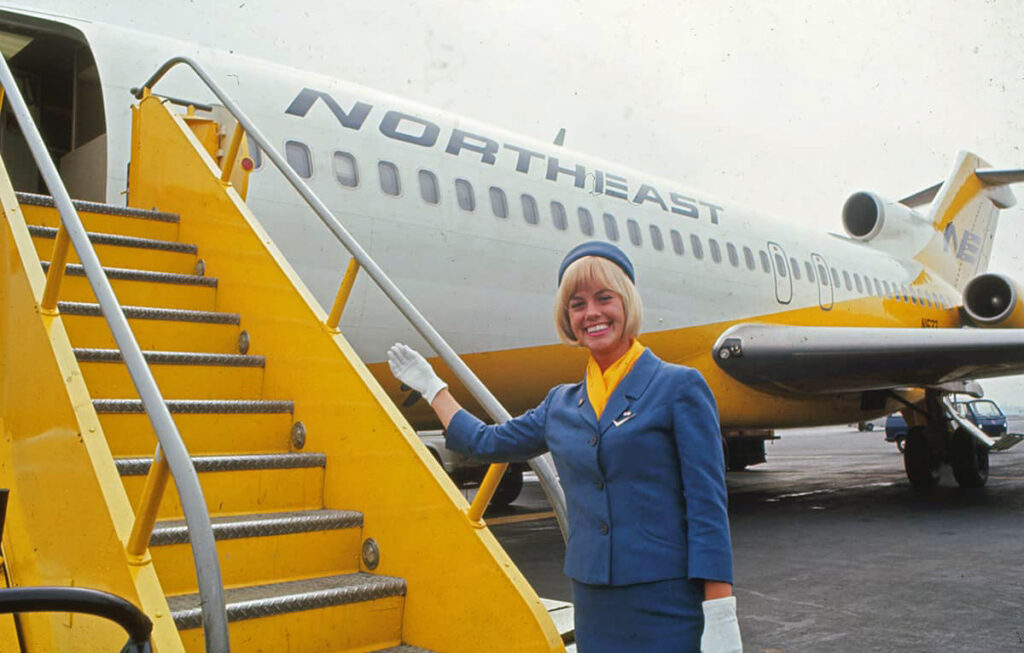
But the airline’s days were now numbered.
Having begun as a northeast carrier with a short-sector, often weather-plagued route system and a sometimes unknown name, competing with major airlines, cast a financial lifeline by new owner Storer, given survival-oriented CAB route authorizations that failed to transform a local service operator into a large one with its few choice destinations, and trying to counter it all with superior aircraft and a colorful, sunshine-suggesting image, Northeast could not achieve profitability with its disjointed, jigsaw puzzle network.
Delta, which stepped in, became its savior, mostly in sprit, and the merger enabled it to obtain Northeast’s Boston hub, its fleet of Boeing 727s, and its routes to Florida, Bermuda, and the Bahamas, transforming it into the fifth-largest US airline in the process.
In the end, Northeast, having always been in search of purpose, passengers, and profits, folded its Yellowbird wings in 1972 after almost four decades aloft.