



Located at Schenectady County Airport in New York State’s Capital-Saratoga region, the Empire State Aerosciences Museum capitalizes on the state’s aviation history in building and exhibits.
“The Empire State Aerosciences Museum is a one-of-a-kind cultural resource located at Schenectady County Airport in the town of Glenville at the site of the former General Electric Flight Test Center,” according to the facility’s self-description. “Dedicated to interpreting aviation, particularly as related to New York State, the museum offers visitors a variety of enjoyable and educational experiences, including interpretive exhibits, a spectacular collection of restored aircraft, and the state’s largest aviation library, as well as educational programs.”
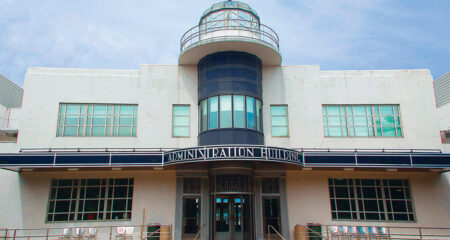
Schenectady County Airport is itself significant to the area’s aviation heritage.
Schenectady County Airport
Historically important in its own right, it was one of the country’s earliest consolidated ones. One of the first airplanes to land there in 1927 was Charles A. Lindbergh’s “Spirit of St. Louis” after it had been shipped back to the U.S. at the end of its successful, solo, transatlantic crossing to Paris.
The following decade was characterized by aircraft manufacturing, military training, and a World War II Army Air Force (AAF) base, enabling it to demonstrate the first jet transport of airmail in 1946. Jet and rocket research and development, in fact, conducted at the General Electric Flight Test Facility and the Malta Rocket Test Station, earned it the unofficial title of “The Little Peenemunde of the US,” referring to the Peenemunde Army Research Center in Germany.
Empire State Aerosciences Museum
Established to inspire and educate about the wonders of flight, the museum, employing the large hangar and outer buildings once occupied by the General Electric Flight Test Center where groundbreaking jet engine research took place between 1946 and 1964, began with a modest four-aircraft collection in 1984, occupying the Richmor Aviation office on the airport’s south end.
“As the years went by, visitation and membership grew exponentially, as did the museum,” according to the facility. “What was once a small collection, now includes over 20 planes in our Airpark, exhibits and interactive displays in two buildings, a simulated reality vehicle ride, and a research library with more than 10,000 books, over 5,000 photographs, and over 6,000 other archival documents.”
Bursting at the seams, the facility moved to the Donovan Building, which is today’s Gallery 2, in 1980, before expanding into the main hangar, which houses Gallery 1.
Concorde Display
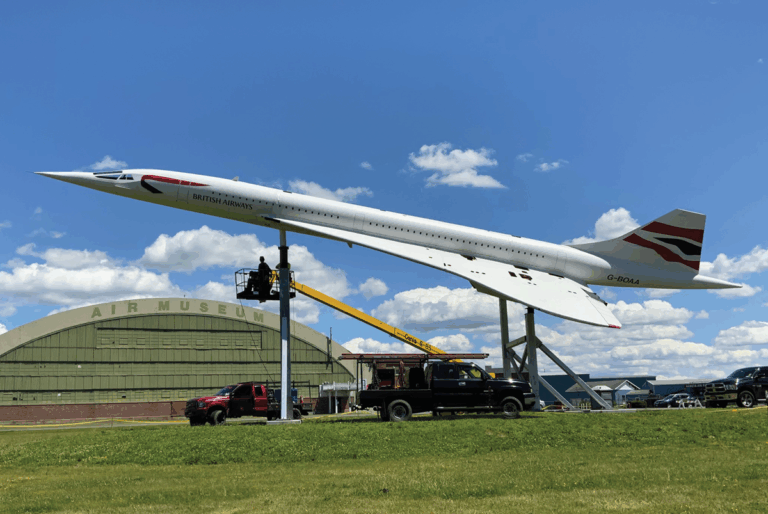
While the sign indicating the Empire State Aerosciences Museum may, at times, be overlooked, the display in front of it on the sprawling lawn is not likely to be—a 102-foot-long, 34,000-pound model of supersonic Concorde—the world’s fastest commercial airliner represented by the world’s largest model.
“This is an exact half-scale replica paid for originally by British Airways, built by L&L Tooling in Texas, and then shipped on five trucks to Times Square in 1995,” according to Dan Wilson, then the museum’s Concorde Project Manager.
“It was something that everybody knew,” Joshua Stoff, Curator of the Cradle of Aviation Museum in Garden City, Long Island, once said. “If you look online at pictures, it was on top of a brewery in Times Square, and it was one of the strange, oddball attractions in New York.”
After the building’s lease expired in 2001, it was dismantled and stored at the Cradle of Aviation Museum but acquired by the Empire State Aerosciences facility in 2017 and trucked to Glenville, at which time it was reduced to a giant, half-dozen-piece jigsaw puzzle. It was initially displayed behind the museum after a year of reassembly, but repositioned, as a single model for the first time, to its current location in June of 2021. Registered G-BOAA, it sports the same registration as the full-size Concorde which landed at Schenectady County Airport during the August 1987 air show.
Gallery 1
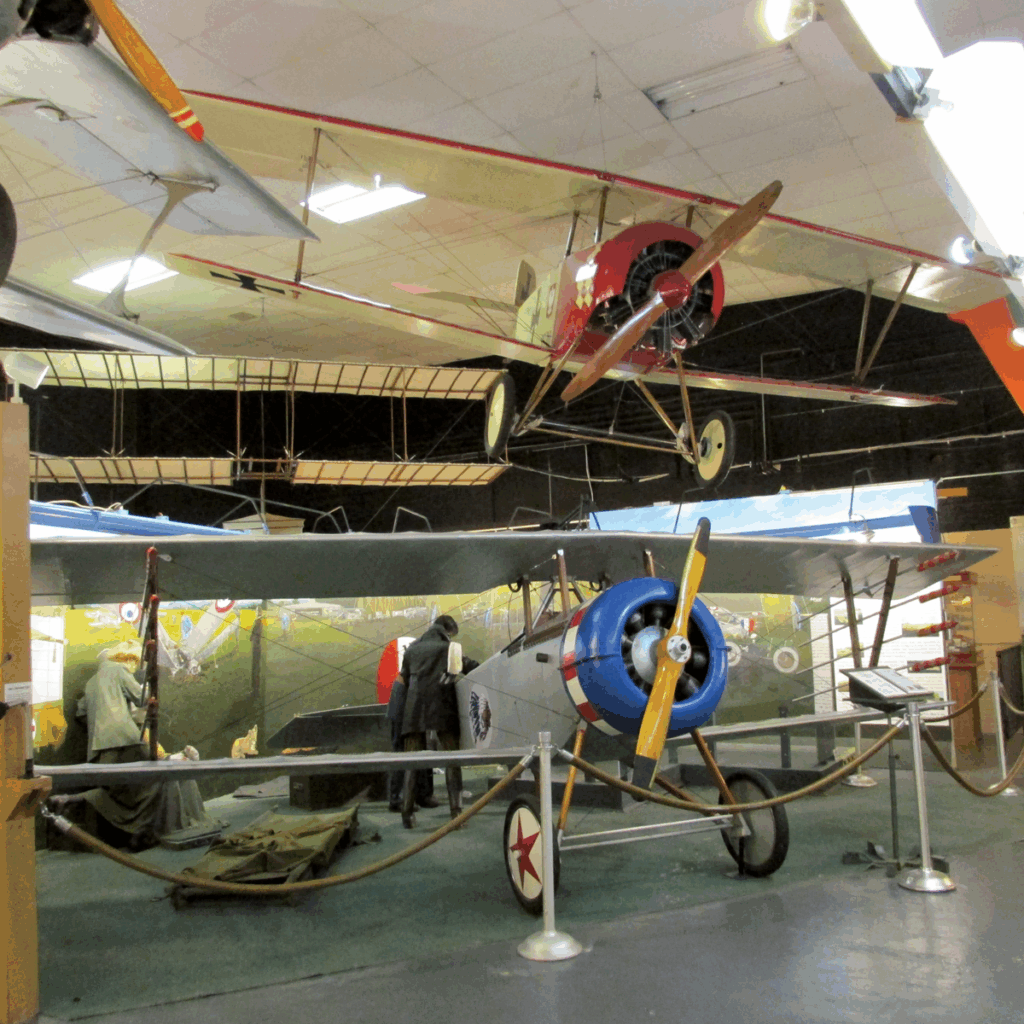
Beyond the small gift shop and check-in desk is the first of the museum’s three display venues, Gallery 1, which features World War I, Amelia Earhart, and 109th Airlift Wing exhibits.
Two of the earliest aircraft here are both unpowered and powered ones.
In the first case, a Chanute glider from 1900 incorporates a panel from the original lower right wing. The muslin covering its airfoil was coated with a solution of paraffin and gasoline to seal it.
In the second case, its 1910 Curtiss Pusher, built and flown by then 19-year-old John von Pomer of Fort Edward, New York, is mostly an original example with its original propeller, control wheel, fuel tank, oil tank, struct sockets, turnbuckles, 42 wing ribs, four struts, wheels, and the undercarriage assembly. It was discovered in a barn belonging to his sister, Sophia, in 1975.
One of the country’s major aeronautical contributions during this period was the Curtiss JN-4 Jenny, which provided pilot training and was instrumental in early airmail development. The museum’s example, a half-scale reproduction, won the Mechanics Illustrated Golden Hammer Award and was donated by the EAA Aviation Foundation.
The two-decade, inter-war period, spanning the 1919 to 1939 period and known as the “Golden Age of Aviation,” was characterized by aeronautical advancement and record flights. One of them, although not ultimately successful, was Amelia Earhart’s global circumnavigation on her Lockheed L-10 Electra.
It is represented in the museum by a 1994 mockup used in the television move, “The Final Flight,” and was flown from Riverside, California, to Schenectady, New York, by the 109th Airlift Wing of the New York Air National Guard.
Instrumental in Schenectady County Airport’s own history, that wing, still present today, is also represented by a Lockheed Hercules cockpit mockup and other related displays.
“Only a year after the Air Force itself was born, the 109th was established in 1948 as a fighter unit,” according to the “109th Airlift Wing History.” “Through seven different types of aircraft, the leadership of 11 outstanding commanders, and ever-changing missions, the men and women of the 109th have succeeded in deploying statewide, worldwide, and from the North Pole to the South Pole.”
The first C-130A arrived in Schenectady in 1971, at which time the unit was designated the Tactical Airlift Group. Four years later, it was entrusted with the first and only active Air National Guard mission—namely, to supply the Distant Early Warning radar sites of Greenland’s polar ice cap—facilitated by an 11-strong C-130 fleet from the Air Force’s Alaskan Command.
Gallery 2
The separate Gallery 2 building, which generally covers the World War II to modern aviation period, can be identified by the large outdoor mural of the Japanese aircraft carrier “Akagi,” whose 18-foot-long indoor model, used in the famous “Tora! Tora! Tora!” film, is one of its centerpieces.
Powered by four geared turbines that collectively produced 131,200 hp and displacing 41,300 war-time tons, it was launched on February 25, 1925 and commissioned two years later, on March 25. It accommodated 12 fighters, 19 dive bombers, and 35 torpedo bombers.
Another significant Gallery 2 display is the one that represents the Malta Test Station, which was established in response to the threat posed by German military rocket development. A General Electric contract with the U.S. government enabled it to design and test the 27,000 thrust-pound X-405 rocket engine and launch the entire Vanguard missile. Space-bound, this display leads to the adjacent one depicting a NASA lunar rover on a simulated moon surface.
Agneta Air Park
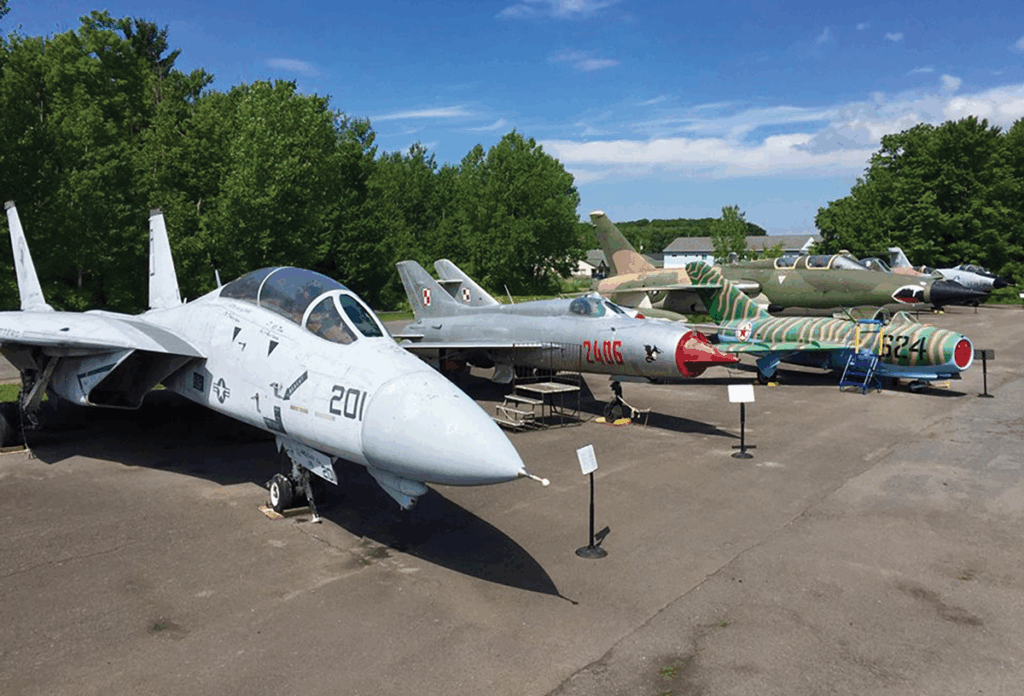
Although some of the museum’s aircraft are housed in the historic hangar in Gallery 1, most are displayed outside, in the Agneta Air Park.
Three, produced only 200 miles south on Long Island, are the A-6E Intruder, the S-2 Tracker, and the F-14 Tomcat, all designed by Grumman. Military aircraft from other U.S. manufacturers are also represented.
The Convair F-102A Delta Dagger, for example—the first American fighter to feature a delta wing—entered operational service in 1956 and was instrumental as an interceptor during the Cold War, defending the country against Soviet bombers when it was operated by the U.S. Air Force’s Air Defense Command. Armed with six air-to-air missiles and achieving an 825-mph speed, it was radar-guided to its targets.
Two North American-manufactured aircraft are also viewable. The T-2 Buckeye, the Navy’s first jet trainer, was instrumental in Naval aviator training, and was not replaced by the T-45 Goshawk until 2005. And the RA-5C Vigilante, first flown in 1958, was a two-seat, carrier-based, heavy attack bomber that solely conducted nuclear strike missions.
Like the Lockheed L-10 Electra displayed in Gallery 1, the Northup F-5E Tiger in the Agneta Air Park had its own Hollywood claim to fame. On loan from the National Museum of Naval Aviation in Pensacola, Florida, and once flown by VFC-13 at Naval Air Station Fallon in Nevada, the aircraft first took to the sky in 1972.
Developed as a simple and inexpensive fighter for foreign air force export, its almost 4,000 examples were delivered to some 30 countries. Because of its two General Electric J-85 turbojets and its Mach 1.6 (or 1,100-mph), it exhibited performance not unlike that of the Russian MiG-21 and, as such, doubled as one in the original “Top Gun” movie’s aerial combat scenes.