


For a carrier whose identity was reflected by its “brightest star” name, it burned out after only a decade and a half, but during that time, it transitioned from a turboprop commuter to an all-jet regional, experiencing growing pains, searching for a niche, reinventing itself, and hopelessly combating companies that could be considered the size of constellations.
Commuter Carrier Origins
Taking its name from “Altairus,” the brightest star in the constellation Aquila, it adopted a blue eagle logo to adorn the vertical tails of its aircraft to further reflect the “eagle” meaning of Aquila itself.
Despite its shine, it began as less than a flicker—a fledgling commuter carrier given wings in July of 1966 for the purpose of connecting smaller cities separated by short distances, initially doing so that December with a Philadelphia-Albany link. Its aircraft, the Beechcraft B80 Queen Airliner, straddled the line between business and passenger types.
Initially designated Queen Air 65 and developed as a commercial version of the US Army’s U-8F Seminole utility transport, it featured a low-wing, twin-piston engine, retractable-undercarriage configuration and first flew on August 28, 1958.
Powered by two 380-hp, six-cylinder, horizontally-opposed, air-cooled Lycoming engines and sporting a 50.3-foot span, it accommodated between seven and nine passengers.

By the summer of 1969, northeast expansion saw Altair touch down in 19 destinations in six states and the District of Columbia—namely, Pennsylvania (Allentown, Bethlehem, Easton, Harrisburg, Philadelphia, Reading, Scranton, Williamsport, and Wilkes-Barre), New York (Albany, Saratoga Springs, Schenectady, Troy, and White Plains), New Jersey (Camden), Maryland (Baltimore), Delaware (Wilmington), Virginia (Richmond), and Washington, D. C. Its highest frequencies were those between its Philadelphia flight base and both Allentown and Harrisburg. It advertised, “Fly the early birds.”
In order to cater to increased demand, it acquired larger aircraft, particularly the 15-passenger Beechcraft 99.
Resembling, in overall configuration, a larger B80 Queen Airliner, which itself had demonstrated the need for a higher-capacity commuter type, it was powered by two nacelle-encased, Pratt & Whitney PT6A turboprops that drove three-bladed, fully-feathering, reversible-pitch, constant-speed Hartzell propellers. The pods themselves stretched from ahead of the cockpit to the wing trailing edge. Entry was through an aft, left, downward-opening, airstair door, and external views were through square windows and a single rear circular one on either side.
At the dawn of the next decade, additional cities were added to Altair’s route system, such as Hartford, Islip, and Bedford, and Philadelphia began to be developed into a bonafide hub. Further seeking to increase the capacity of its aircraft, it acquired still-larger Nord 262s from Denmark-based Cimber Air in 1975.
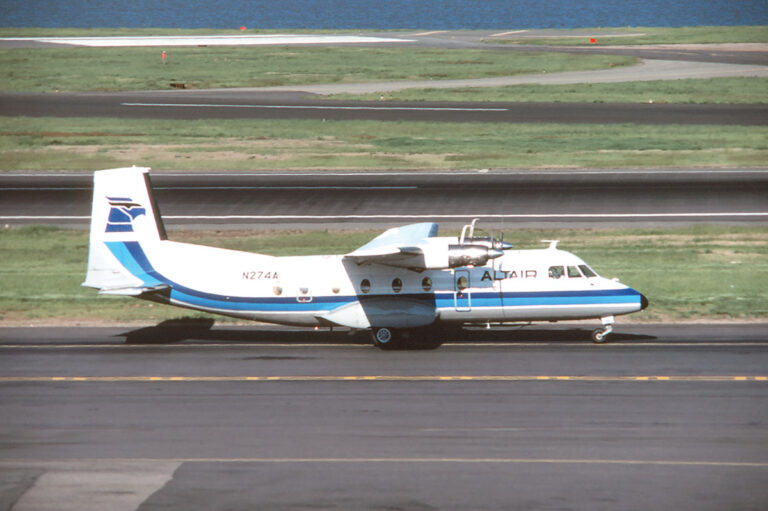
Powered by two 1,080-hp Bastan VIB2 turboprops, the French design initially flew in prototype form on December 24, 1962. The first production example, featuring a dorsal fin for increased vertical axis stability, took to the sky two years later, on July 8, 1964, and was awarded its French type certification eight days later.
Featuring its own self-contained airstair door and elliptical passenger windows, it accommodated 26 in a three-abreast configuration with an offset aisle- or 11 more than its Beechcraft 99s.
The coveted goal of any foreign aircraft manufacturer was penetration of the U.S. market and Nord Aviation succeeded in doing so when Lake Central Airlines ordered a dozen 262s and inaugurated the first into service in May of 1965. Always in search of purpose and profit, Altair often dropped destinations like hot potatoes.
By 1979, with Philadelphia now firmly established as its hub, it flew to Newark, White Plains, Islip, Binghamton, and Elmira in New York; Wilkes-Barre, Allentown, Harrisburg, and Pittsburgh in Pennsylvania over and above its home base; Wilmington in Delaware; and Baltimore, Washington, Richmond, Raleigh-Durham, Charlotte, and Myrtle Beach in the south.
On the cover of its July 15, 1979 system timetable, it stated, “Announcing the Philadelphia-Allentown Shuttle, Monday through Friday, connecting Allentown with every major city in the USA and Europe,” although this claim could only be fulfilled with other carriers for final-destination travel.
Regional Jet Era
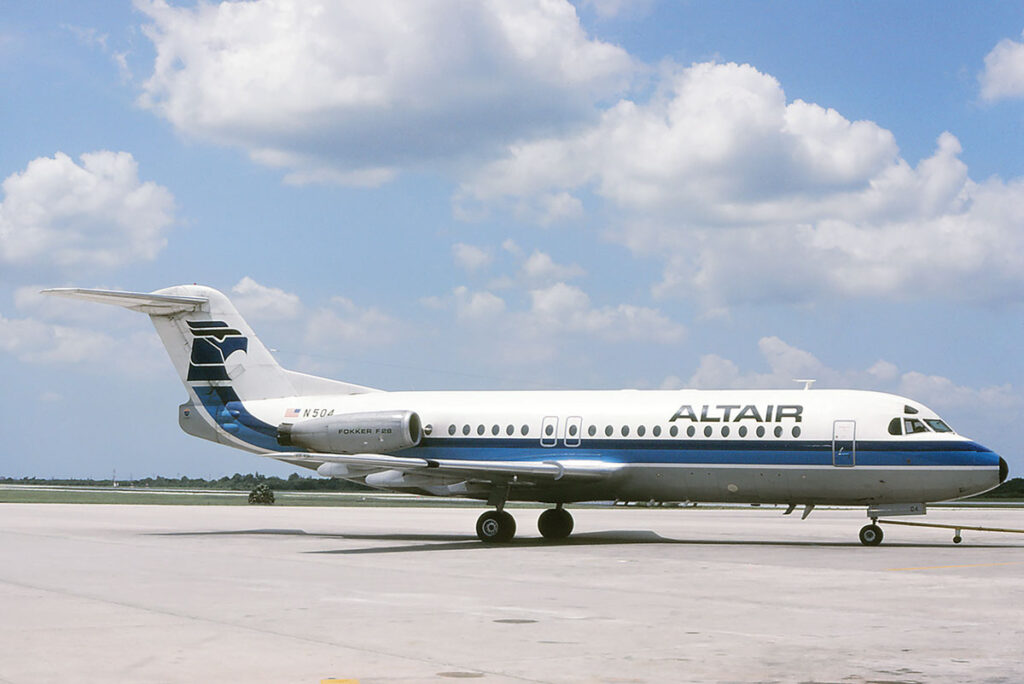
Although deregulation facilitated unrestricted expansion for Altair and all other US airlines alike, its acquisition of six factory-fresh Fokker F.28-4000 Fellowships beginning in August of 1980 enabled it to entirely restructure itself and portray a “larger carrier” image by offering greater speed, range, and comfort.
Having assessed the regional market with its turboprop F.27 Friendship, Fokker, a name synonymous with aircraft such as the Dr.1 triplane during World War I and the early F.VIIA/3m trimotor airliner, announced the turbojet F.28 Fellowship as both a higher-speed complement to and successor of it at the 1962 Hanover air Show. Intended for low-capacity, short-range routes, which served limited-facility, sometimes unprepared fields that received no previous jet operations, it became the world’s second purposefully-designed regional jet after the Yakovlev Yak-40, but accommodated two to three times as many passengers in a significantly wider fuselage.
“The F.28 twin-turbofan airliner is designed to serve the short- to medium-haul sector of the commercial aviation market,” according to the Fokker F28 Technical Data publication (Fokker-VFW International, p. 1). “Within that area, it serves a dual purpose. It brings jet speed and comfort to regions which previously have known only turboprop or piston-engine equipment. And it offers the advantage of moderate capacity to carriers operating domestic, regional, and charter services mostly from well-equipped airports.”
Powered by two aft-mounted Rolls Royce RB.163 Mk 555 Spey Junior turbofans, it featured a 16-degree swept-back wing, a t-tail, and a unique pedal airbrake, which facilitated steep, controlled descent profiles without the need for power changes.
Accommodating 74 five-abreast passengers in the -4000 series Altair purchased, it offered full-size jet-equivalent speed and far greater range than its turboprops had. It also signaled a completely restructured route system, stressing longer distances.
From Philadelphia, it flew to Boston, Buffalo, and Rochester in the north, and Norfolk, Greensboro, Raleigh-Durham, Charleston, Savannah, Birmingham, and Memphis in the south. More importantly, however, was its Florida reach, enabling it to tap into tourist traffic for the first time and connect the city of brotherly love with Jacksonville, Tampa, and Sarasota. Its new slogan expressed its new-found freedom—namely, “Altair makes flying easy.”
Its “Starjet service” on these relatively long-range routes–in compassion to the hops it initially made as a commuter carrier–was sterling: complementary aperitifs, spirits, wine, beer, soft drinks, and juices, and a chilled, multiple-course repast presented on flight attendant-offered trays, consisting of seasonal salads; jumbo shrimps with cocktail sauce; reubens of corned beef, swiss cheese, sauerkraut, and thousand island dressing; a cheese board with gouda, bleu, swiss, and cheddar accompanied by crackers; a fresh fruit tray of strawberries, red grapes, orange sections, and pineapple slices; a selection of liqueurs; and coffee or tea.
Anticipating still-greater demand as it transformed itself into more of a major airline, it acquired three larger, longer-range McDonnell-Douglas DC-9-30s from Air Canada.
Darkened Star
While it ultimately achieved its brightest-star image and service, its dwindling finances reflected its undercapitalization, overexpansion, battle with the USAir and Eastern “big boys” at their highly established Philadelphia hubs, and inability to meet its expenses, particularly its more than $1 million fuel debt to Gulf Oil Corporation.
Like the plug pulled on a lamp, its light abruptly darkened when it filed for Chapter 11 bankruptcy protection on November 9, 1982 and ceased operations, leaving its now nine-strong F.28 and DC-9 fleet still and silent at Philadelphia International Airport, no longer able to reach for the stars.