


Many small, independent airlines, which operated a handful of turboprop aircraft within a limited catchment area, were later propelled into the major ranks because of three main aviation trends: deregulation, major carrier alignment, and the new breed of regional jets. Comair was one of them. But success can sometimes lead to failure if independence is lost —and in Comair’s case, it was.
Origins and Early Growth
Voids often serve as catalysts to their fulfillment, which, in many ways, was the reason for Comair’s creation.
The airline can trace its origins to two Eastern Airlines employees, Patrick Sowers and Charlie Fugazzi, whose vision, leadership, and entrepreneurial drive laid the groundwork for its foundation. The former, who became its first president, along with co-founders Robert Tranter and the Mueller family (David and Raymond), established it, building on the operational and strategic lessons from Wings Airlines, which itself had been created the previous year.
David Mueller himself, a corporate pilot, noted a shortage of area air service whenever he flew, and he elected to fill this gap with his father, Raymond, by taking the initial idea and offering high-frequency flights between cities that sorely needed them. Comair, needless to say, was the result, and it came into being on April 1, 1977.
Its initial fleet was modest by any standards—a trio of seven-seat, piston-powered Piper Navajos, which barely crossed the bridge between general and commuter aviation, and their base was the Greater Cincinnati/Northern Kentucky International Airport. The air service shortage was finally addressed, plugging the gaps to Akron, Cleveland, and Detroit.
Deregulation
Deregulation, gateway to growth, endowed Comair with new freedoms, enabling it to enter and exit markets, establish frequencies, and set its own fares.
“The company benefitted from the deregulation of the airline industry in the early 1980s,” according to ‘History of Comair Holdings.’ “As the major airlines dropped unprofitable routes in the face of intensified competition, Comair and other regional fliers were quick to fill in the gaps in service.”
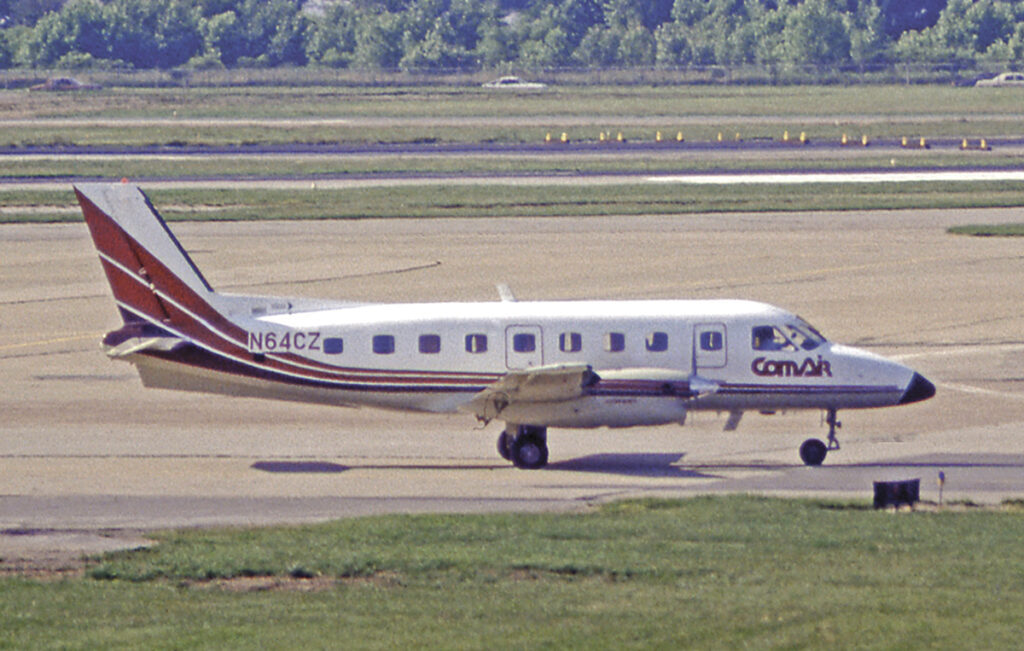
Shortly after the dawn of the decade, the carrier acquired 30-seat Embraer EMB-120 Brasilias and 34-seat Saab 340s, both of which were pressurized, featured stand-up aisles, and offered in-flight service. An IPO raised $5.5 million after trading on NASDAQ, ensuring the airline’s expansion.
Delta Cooperation and Connection
Sometimes statements are subtly made. In the case of Delta Airlines, it made one by allowing Comair to list its flights in its Deltamatic computerized reservations system (CRS) at the end of 1981. It ultimately led to a marketing agreement and Delta Connection cooperation. The statement was simple: Comair was doing something right and an agreement with it could offer Delta advantages it could not achieve on its own.
Although an initial Comair-to-Delta inter-flight feed only entailed those to 15 destinations in seven states, by 1984, the joint venture expanded to encompass 100 daily departures from Cincinnati.
But passenger make up had begun to shift —from its primarily business one to a leisure one, facilitated by connections to Delta flights and, as such, Comair itself inaugurated service to destinations catering to this class of clientele. By July of 1987, it operated a 37-aircraft fleet to 29 cities.
Leisure, indeed, dictated its direction. When Delta became Walt Disney World’s official airline, it needed additional flight feed at its Orlando hub, and Comair fit the bill by establishing its second hub there on November 1, 1987, initially with 19-seat EMB-110 Bandeirantes, but later with its larger EMB-120s.
“By 1992, Comair’s Delta Connection system in Florida had expanded north to Savannah, Georgia, and Birmingham, Alabama, and west to New Orleans,” according to ‘Sunshine Skies: Exploring the History of Commuter and Regional Airlines of Florida and Georgia.’
Aside from feeding each other passengers, Comair and Delta also injected each other with strengths, establishing an interdependence.
Regional Jet Era
Small jets seating between 45 and 90 passengers had already been designed during the 1960s, 1970s, and 1980s. But their success hinged upon powerplant availability. General Electric’s quiet, fuel-efficient, optimum thrust CF34 series made a new breed both feasible and economical.
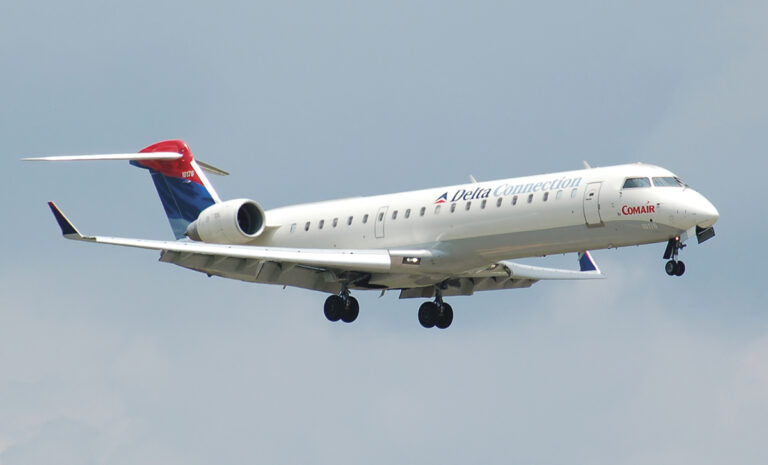
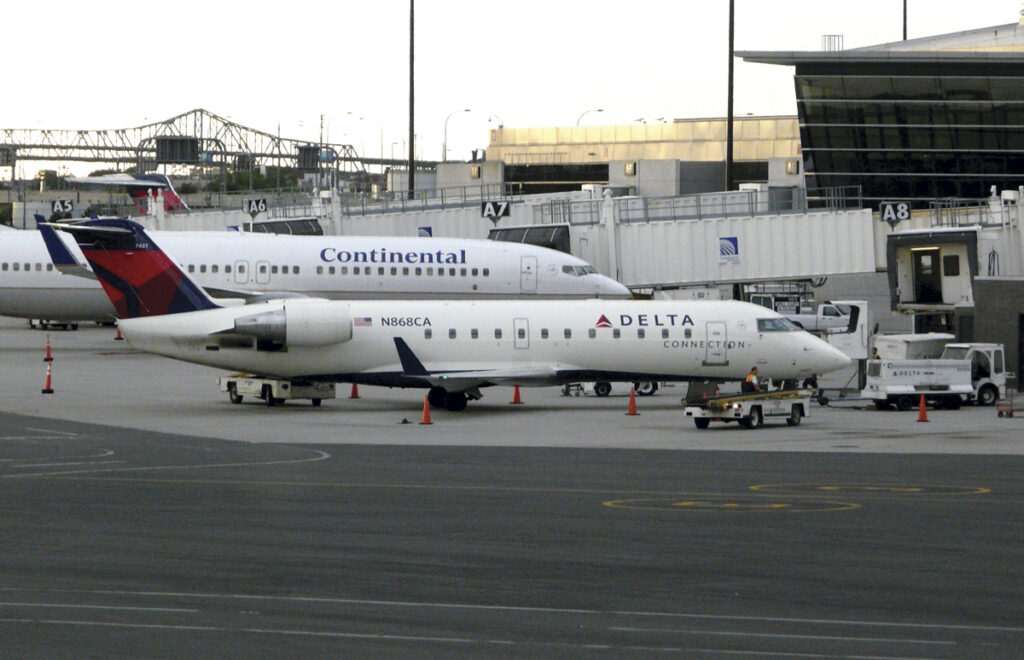
Comair became the US launch customer for what was originally known as the Canadair, but later Bombardier, Regional Jet.
From its very first flight from Cincinnati to Toronto on June 1, 1993, it became apparent that it not only introduced a new aircraft type, but a new concept. Aside from its mainline-jet comparable comfort and, in some cases, range, its greatest advantage was its speed, especially in its ability to operate within the Delta Connection program.
“We needed more real estate,” according to Charles Curran, the airline’s Senior Vice President of Marketing. “The turboprop can only go so far. We wanted to expand our hub and attract more people to Delta, and we needed a jet to do that. The RJ has opened markets that, previously, we couldn’t even think about.”
As a niche carrier, the type allowed Comair to blur the lines between its previously turboprop-only operation and Delta’s exclusive-jet one, enabling it to supplement or replace turboprops on routes of between 100 and 1,500 nautical miles, inaugurate service in new markets, entirely or partially substitute Delta mainline jet flights to maintain or even increase frequencies and allow sector demand to grow and mature until larger aircraft could be deployed.
“… Comair’s operations are shaped to appear as any other flight leg of Delta Air Lines,” according to Carole A. Shifrin in her article, ‘More Small Jets Enter Regional Fleets’ (Aviation Week and Space Technology, May 12, 1997). “The Delta Connection carrier shares Delta flight numbers, ticketing/advanced seat assignment, frequent flier benefits, and automation through-baggage service to the final destination.”
The explosive, regional jet-sparked growth frequently required airport facility expansion. In September of 1994, for example, Comair opened a $50 million, 53-gate one dedicated to regional operations in Terminal C at Cincinnati. Three years later, the combined Delta and Comair flight schedules from it had a 450-city, 80-country reach, with the latter’s regional jets spreading their wings to destinations in the Midwest and to the East Coast, the South, Florida, and Canada.
As the nation’s third-largest regional airline hub, it demonstrated the potential of this new breed of mini-jets. They significantly increased its catchment area, funneled an ever-higher number of passengers through it, and facilitated an infinite number of Comair-to-Delta and Comair-to-Comair flight connections.
Virtually overnight, Comair recorded record revenues of $297 million, of which $28.5 million were profits, and carried 2.7 million passengers. For the fiscal year that ended in March of 1997, that revenue had almost doubled to $563.8 million.
“Comair was outperforming its regional airline rivals because its jets, which numbered more than 50 by 1997, enabled the airline to start new routes, cater to business travelers and command higher prices,” according to ‘History of Comair Holdings.’ “While other regional carriers were scrambling to catch up by purchasing their own regional jets, Comair had, by 1997, vaulted into the number two spot among the regionals, trailing only AMR Corporation’s Simmons Airlines.”
Two years later, it carried 6.44 million annual passengers on more than 750 daily departures and earned $763.3 million in revenue.
Delta Ownership
Faced with reverting to autonomous operation, concluding a similar code-share agreement with another carrier, or being financially acquired by Delta when its original Delta Connection contract ended, Comair chose the latter option, paving the way for its ownership change on October 18, 1999, after a $1.8 billion purchase, which equated to $23.50 per share. A wholly owned subsidiary by the following January, it became part of the new Delta Connection, Inc. unit, which oversaw all of Delta’s regional carriers, including ASA Atlantic Southeast Airlines.
That Comair’s meteoric rise to success prompted the strategy could not be disputed, but its quality was confirmed when it won Air Transport World’s 1999 Regional Airline of the Year award.
Its growth, facilitated by additional regional jet acquisitions, was the equivalent of unstoppable momentum.
In April of 2000, for example, Delta signed a $10 billion contract for 500 firm- and optioned- orders for its ASA and Comair subsidiaries to complete their turboprop aircraft replacements.
“The CRJ deal is the first fleet purchase for Delta Connection, formed last year after ASA and Comair became wholly owned subsidiaries of Delta,” according to Graham Warwick in his ‘Delta Signs Massive CRJ Deal’ article (Flight International, April 4-10, 2000). “The 94 firm orders, valued at $2 billion, consist of 25 40-seaters and 20 44-seaters, all for Comair (along with seven stretched CRJ700s).”
After delivery, the once-fledging and independent Cincinnati carrier operated an 182-strong regional jet fleet.
Hinged Success
Comair’s success now hinged upon Delta’s, and if its new owner entered a decline, the win-win equation would rapidly invert into a lose-lose one, which it eventually did.
On September 14, 2005, parent Delta was forced to file for Chapter 11 bankruptcy, financially affecting affiliate Comair. Cost reductions could only be achieved through flight, city, frequency, and personnel reductions.
An early-2008 Delta domestic capacity decrease forced a similar one at Comair, and two years later, it ceased operating the very aircraft that had catapulted it to success —all of its original, short-fuselage, 50-seat CRJ100 and -200 regional jets.
Yet another two years later, Delta implemented the unthinkable: it pulled the plug on Comair, shutting it down. At its peak, it had served 83 destinations in the US, Canada, the Bahamas, and Mexico.
Lessons and Legacy
Deregulation, the Delta Connection code-share agreement, and the regional jet had all infused Comair with unprecedented growth and success—so much so, in fact, that Delta purchased the very arm without which it itself could not have grown the way it did. But that success became inextricably tied to its owner and, ultimately devoid of choice and independence, led to its demise.