



Although Grumman was principally a supplier of fighters to the US Navy, Marines, and Coast Guard, it nevertheless found limited airline application for its amphibious G-21 Goose, G-44 Widgeon, and G-64 Albatross aircraft. Even more successful in this role was its G-1 Gulfstream corporate and executive landplane transport.
Grumman Gulfstream G-1
Following his previous strategy of offering a series of amphibious aircraft targeted at the private and commercial market, Leroy Grumman made an impromptu decision to design a more modern, land-based turboprop counterpart in an effort to expand beyond the traditional military market on which he had relied and avoid laying off otherwise unneeded, but experienced engineering staff.
Catalyst, to a degree, to this design was the appearance of the Rolls Royce Dart turboprop on the Vickers Viscount, a quad-engine airliner from Great Britain, and the first turbine one. As the country’s best-selling commercial aircraft, with 444 produced, it demonstrated, particularly through its speed and passenger acceptance, its potential for a smaller corporate counterpart. Bethpage, Long Island-based Grumman Corporation, took notice of it during the 1950s.
Market studies of, and feedback from, numerous Fortune 500 companies indicated the need for such a corporate transport cruising at 350 mph and covering 1,800- to 2,200-mile sectors. Because of the speed advantage of the turbine and the proven reliability of the Rolls Royce Dart engine, it was decided to optimize an airframe around it.
A radically divergent “design solution” that incorporated both performance and economy, the low, straight-wing monoplane, designated Model 159, ultimately sported a 78.4-foot span, but power transitioned from the piston engine to the turbine.
The engines, in the event, were versions of those that powered the Viscount—in this case, 2,210-shp Rolls Royce Dart 529-8s that drove four-bladed propellers, giving it its 334-mph cruise speed. Its maximum takeoff weight, range, and service ceiling were, respectively, 35,000 pounds, 2,500 miles, and 36,900 feet.
Unlike its amphibious counterpart, the Goose, it had a conventional fuselage, in which ten business and up to 24 three-abreast, high-density passengers sat, with views through circular windows, and the aircraft itself rested on a retractable, tricycle undercarriage.
Indicative of Grumman’s quality and innovation were its many advanced features, which included the first tail-installed gas turbine auxiliary power unit (APU); an airbrake that was extendible up to its 310-knot never-exceed speed to facilitate rapid, controlled descents, and an extensive cockpit warning and monitoring system that could be considered the forerunner of today’s engine indicating and crew alerting system (EICAS).
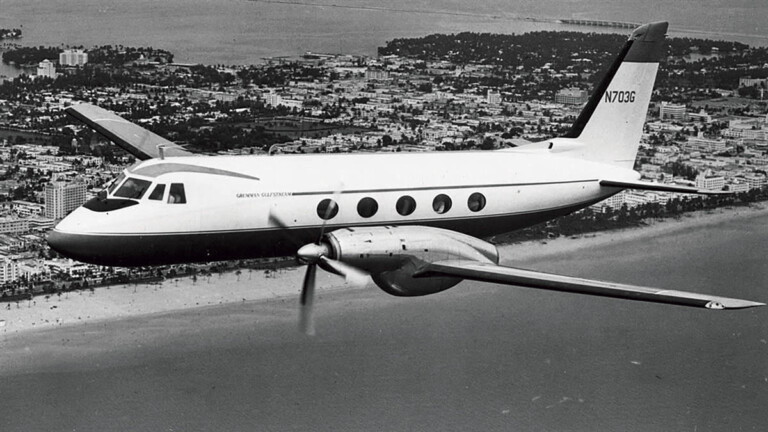
Three examples encompassed the flight test program—the first, N701G, first flying from Bethpage on August 14, 1958; the second, N702G, on November 11; and the third, N703G, on February 12 of the following year. Type approval was attained on May 21.
By the following year, 32 of this new breed of turboprop aircraft plied the skies.
Sinclair Oil, the first customer for the type, became representative of the many corporations that operated it for employee transport.
During the 11 years between August of 1958 and May of 1969, 200 G-1s were built.
Grumman Gulfstream G-1 Operators
While the Grumman Gulfstream G-1 found favor with its intended corporate audience as an executive aircraft and often replaced smaller, slower piston types, such as the Beech 18, many carriers deemed it a suitable turboprop regional airliner that could accommodate up to 24 passengers.
Twenty-five of the 200 built were deployed in Canada, where it was able to serve as a multi-role airplane, connecting distant cities and settlements faster than any piston type could. Low acquisition prices of used aircraft enabled operators to carry passengers as transports and cargo as freighters. Air Inuit, North American, and Wardair supported natural resource development, often in remote Canadian regions, with it.
Ideal for scheduled commercial operations, it was flown by Air Sask (La Ronge Aviation) in Saskatoon, City Express in Ontario and Quebec, and First Air (Bradley Air Service) in the western Arctic.
Cross-utilized as a cargo carrier, the G-1 often transported freight and small packages throughout the night when there was no passenger demand.
Air South, Bonanza, Golden West, Zantop, and Air US operated the G-1 as a regional airliner in the US. The latter, the commuter division of US Aviation based in Denver, was established on April 1, 1977, linking Riverton, Wyoming, with Denver with a single ten-passenger Piper Navajo Chieftain. Gillette and Sheridan, both in Wyoming, were later added.
Expansion, achieved by means of filling the void left by Frontier Airlines as it progressively discontinued unprofitable routes and an interline agreement with United to feed its flights in Denver, was facilitated by larger equipment—first with 18-passenger British Aerospace BAe-31 Jetstreams and then 24-passenger Grumman Gulfstream G-1s, a half-dozen of which it ordered.
“The large turboprop Grumman Gulfstream helped Air US join the ranks of a true ‘airline’ with comfort, speed, and safety over the rugged Rocky Mountains,” according to the “Air US” article in Departed Wings (Internet).
Royale Airlines also operated the type in the US, feeding Continental Airlines flights under “Continental Connection” branding.
Orion Air carried cargo on its ten-strong fleet from its Atlanta base.
The G-1 crisscrossed the European continent, providing both local and international service.
Birmingham Executive, for instance, which was later renamed Birmingham European, plied its scheduled routes with it and even crossed the English Channel with it, linking both Dusseldorf and Frankfurt with its Birmingham hub between September 1986 and 1987.
Eventually operating 50 weekly flights, Brown Air inaugurated Gulfstream G-1 service between its Leeds/Bradford base and Glasgow and between Glasgow and Cardiff in April of 1986.
Peregrine Air Service, which acquired second-hand examples from the US, initially used the type to operate charter flights to support oil production but later established a UK domestic route system, operating on behalf of British Airways.
Gulfstream G-1 service was hardly restricted to the UK, however. Cimber Ai operated the type in Denmark, Air Provence did the same in France, and Aero Speciali flew it between Bologna in Italy and Birmingham.
Aero PAR touched down in small communities in Venezuela with its G-1s.
Fitted with an aft, port, 62-by-84-inch cargo door, the type was flown by small package carriers DHL and Purolator.
Gulfstream G-1C
Of even greater regional airliner application was the Gulfstream American (later Gulfstream Aerospace) G-1C, which was specifically modified for this market after the Savannah, Georgia-based company acquired the G-1 tooling and design rights from the Grumman American Aviation Cooperation in 1978.
Briefly designated “G-1C Commuter” to emphasize its purpose, it was the result of both marketing and structural/engineering studies to determine the need for, and feasibility of, stretching existing airframes to accommodate between 32 and 38 passengers, the latter 14 more than the original G-1’s capacity.
Featuring a reshaped nose, a wraparound windscreen, and a 10.8-foot longer, light alloy fuselage, the G-1C had a new 74.4-foot overall length. Rectangular passenger windows, replacing the existing circular ones, were contemplated but never incorporated.
It retained the 78.4-foot, 610.3-square-foot straight wings of its predecessor, its aerodynamic surfaces restricted to trailing edge flaps and ailerons for lateral control.
Power was provided by two 2,210-shp Rolls Royce Dart Mk 529-8 turboprops that drove four-bladed, 10.6-foot-diameter, constant-speed propellers.
Standard configuration in the restyled interior included a forward lavatory and garment closet, 38 three-abreast seats at a 29-inch pitch with an offset aisle, and a 144-cubic-foot aft baggage compartment.
The G-1C’s payload, gross, and maximum landing weights were, respectively, 7,600, 36,000, and 23,850 pounds. Its service ceiling was 30,400 feet. Range, with its full payload and reserves, was 540 nautical miles.
A simple stretch of an existing G-1 airframe, registered N5400C, first flew from Bethpage, NY, on October 25, 1979, for fight testing and demonstration purposes, and the aircraft was FAA-type certified the following year.
Burlington, Vermont-based Air North was the type’s launch customer; established itself as a regional airline in 1967, it progressively expanded, operating as the commuter arm of Mohawk Airlines the following year and becoming part of the Allegheny Commuter consortium after Allegheny’s takeover of Mohawk in 1973.
“The 1C is a modification of the Gulfstream 1 originally devised and built as a corporate executive transport, whose fuselage has been extended by almost 11 feet to increase its seating capacity to 37 passengers for commuter-type service,” according to Carole Shiftin’s “Air North Begins D.C.-Rochester Service” article in the November 28, 1980 edition of The Washington Post. “It is powered by two Rolls Royce Dart turboprop engines, is fully pressurized, and can cruise at a speed of about 350 mph.”
By the end of 1981, five G-1Cs had been ordered by Air North itself, Air US, and Chaparral Airlines. Despite its greater-capacity promise, however, it attracted little interest, and both the conversion program and the possibility of new-build aircraft production quickly waned.