

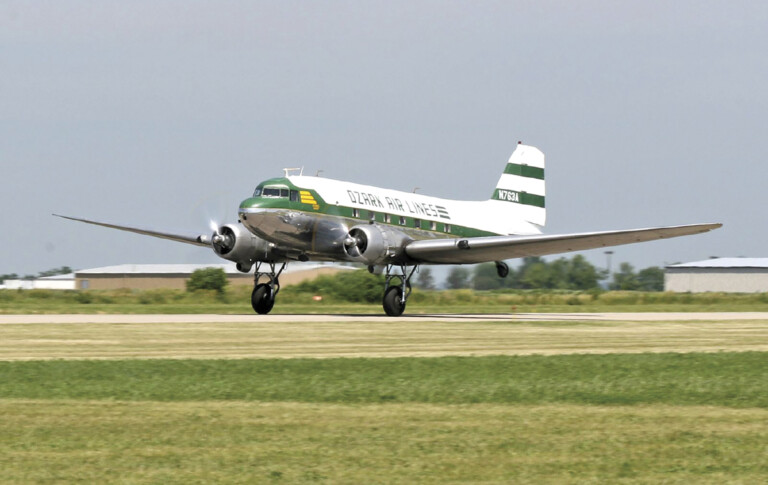
The First Ozark
Many airlines, especially during the early years of aviation, planted seeds in parts of the country that became their hubs and around which their initial route systems grew. For Ozark Air Lines, that seed was planted in Missouri soil, its hub became St. Louis, and its initial route system encompassed the Midwest.
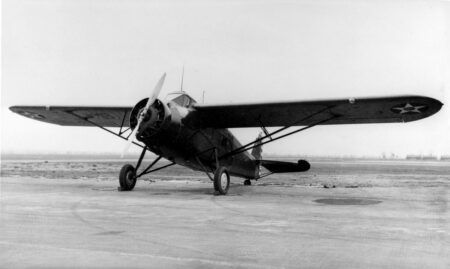
Its origins stretch as far back as 1933 when it first flew between Kansas City and Springfield, Missouri, with high-wing Stinson aircraft, but it was short-lived, lasting only until the next year.
The Second Ozark
Although a second version was established a decade later, in 1943, to serve Springfield from St. Louis, it was unable to get off the ground and only achieved operational status after it was awarded routes originally granted to Parks Air Transport.
While most of the local service carriers were synonymous with the Douglas DC-3, Parks had intended to operate smaller, less-reliable types, which failed to meet the Civil Aeronautics Board’s (CAB) minimum-standard equipment requirements.
“The CAB was unable to enforce the requirement because the first operating certificates were issued only on a temporary basis,” according to R. E. G. Davies in Airlines of the United States since 1914 (Smithsonian Institution Press, 1998, pp 391-392). “If airlines could not demonstrate sufficient technical ability or corporate strength by the time the renewal of the certificate was due, they forfeited the franchise.”
Parks’ loss thus became Ozark’s gain, and it was able to inaugurate scheduled service on a Springfield-Decatur-Champaign-Chicago route on September 26, 1950 with a fleet of four DC-3s.
Five years later, these aircraft numbered 13 and they touched down in 35 cities, among which Sioux City, Iowa; Indianapolis, Indiana; Wichita, Kansas; and Nashville, Tennessee, were the sizeable ones. Three years later, 20 DC-3s wore its livery, which eventually featured three swallows on their vertical tails.
It was during this time that Ozark was able to further expand, because the 1958 Seven States Area Case provided route network extensions to it, along with other local service carriers, such as Central. Frontier, and North Central.
At the dawn of the next decade, larger, more modern aircraft replaced the earlier ones, including its first turboprop type, the Fokker F.27 Friendship, in 1960, and the Martin 404, which it acquired in an equipment swap with Mohawk Airlines, in 1961.
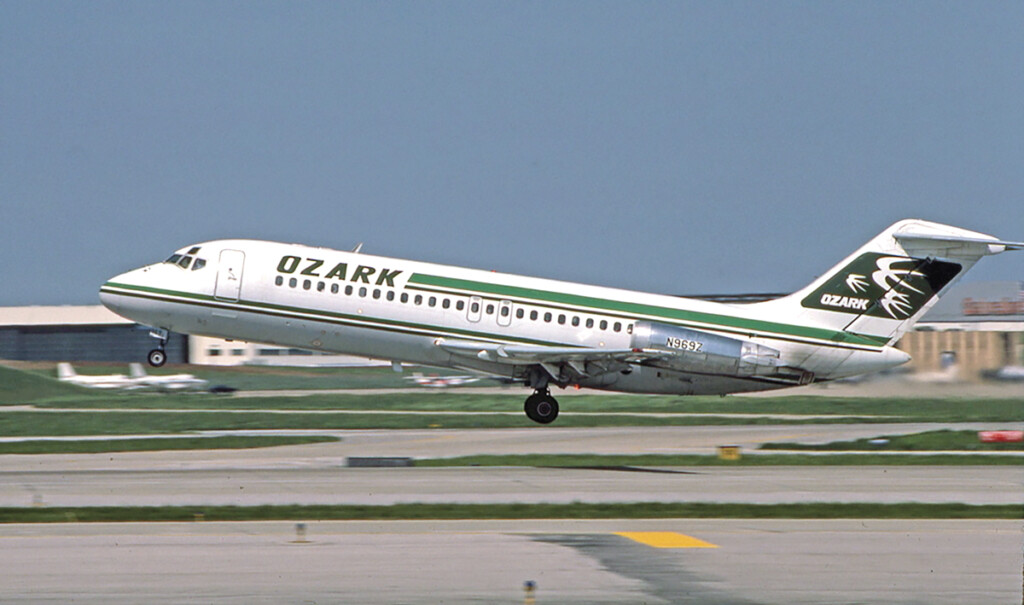
By the early-1960s, Ozark’s catchment area was bounded by Minneapolis, Omaha, St. Louis, and Chicago. On July 8, 1966, it significantly enhanced its image by introducing the first jet, a DC-9-10, and it was later followed by the higher-capacity DC-9-30.
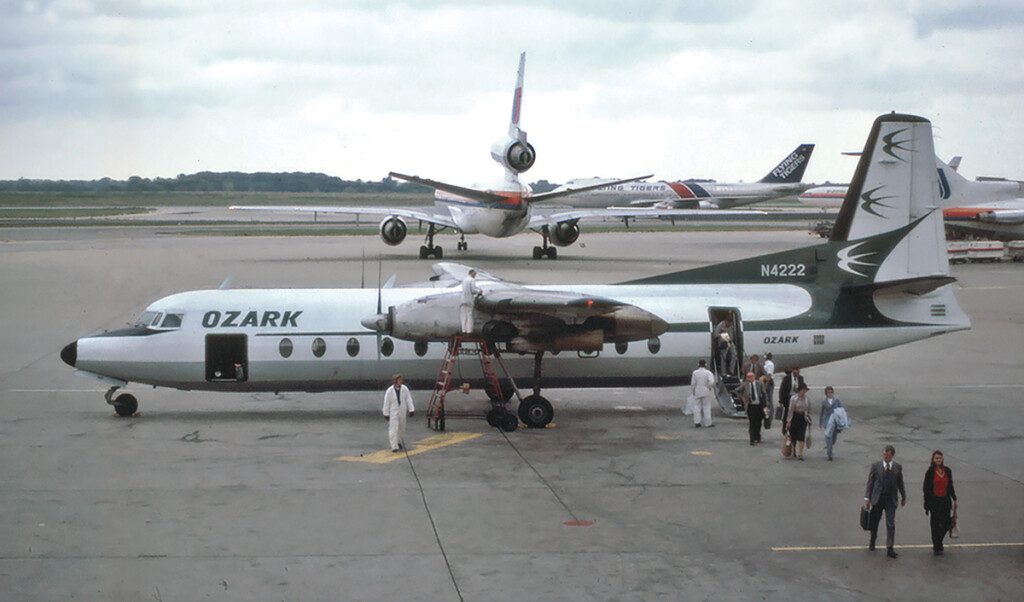
An earlier, January 1965 order for 18 FH-227s, a stretched version of the F.27 license-built by Fairchild Hiller in the US, enabled it to offer increased capacity on lower-density routes when the first was placed in service on December 19 of the following year.
The route system also expanded. Denver was added in 1966, Washington-Dulles and New York-La Guardia enabled it to reach the east coast three year later, and in 1978, it touched down in Atlanta and four Florida destinations.
Although Ozark, the youngest of the local service carriers, was not established during deregulation, its expansion was facilitated by it, enabling it to carry 3.8 million passengers in 1980, when it retired its last FH-227, and 4.1 million in 1981, when it recorded a $17.1 million profit.
“It attributed its $17.1 million 1981 net profit to increased productivity, better service to the passenger, the fuel economy of its exclusively DC-9 fleet, and the opportunity that deregulation has given it to develop its hub system, based at St. Louis Lambert Field,” according to the “Nationals Shine Through 1981 Gloom” article in Flight International (March 6, 1982, p. 525).
By 1982, it operated seven 80-passenger DC-9-10s and 34 110-passenger DC-9-30s, and served 48 US destinations with 90 daily, all-jet departures from its St. Louis hub. Although these increasingly encompassed the major ones, such as Chicago, Dallas/Ft. Worth, Detroit, Denver, Houston, Kansas City, Las Vegas, Miami, Minneapolis, and Washington, it was still loyal to its small-town routes, continuing to touch down in places such as Champaign/Urbana, Decatur, Moline/Davenport, and Peoria, prompting it to adopt the slogan, “Ozark flies your way.”
It offered two daily nonstops from New York-La Guardia, claiming that it “served St. Louis and the entire Midwest.” The highest frequencies from that hub, ranging from four to eight per day, were to Chicago, Dallas, Des Moines, Kansas City, Milwaukee, Minneapolis, Springfield (Missouri), Tampa, and Washington.
Its expansion was emphasized by its March 1, 1982 system timetable.
“Fly with us to Virginia, Texas, and Florida,” it stated. And “Ozark’s Bigger Orange; Now serving Sarasota-Bradenton and Ft. Myers,” which brought to half a dozen, along with Ft. Lauderdale, Miami, Orlando, and Tampa, the number of destinations it served in Florida.
“Now ten times a day to Florida,” it advertised. “With the introduction of service to these popular Gulf Coast areas, Ozark’s Big Orange is bigger than ever. From both Chicago and St. Louis, it’s one plane all the way. And we give you excellent connections from dozens of other Midwest cities to all six of our Florida cities.”
“500, 600, and 900 series flight numbers were operated by DC-9 jets,” it pointed out. “Cocktails were available on most flights after 9:00 a.m.” And “Flair Service,” featuring meals served by outstanding restaurants on its route system or cuisine suggested by its flights attendants, with wine, were offered on select sectors.
Because some of the smaller communities were unable to generate sufficient traffic to fill its DC-9-10s, Ozark concluded a code-share agreement with Air Midwest in 1985, in which the rebranded “Ozark Midwest” provided feed in St. Louis with its Fairchild Swearingen Metro turboprops,
Like most of the former local service carriers, whose expansion elevated them to US National status, Ozark became the target of a takeover—in this case, by TWA, whose own St. Louis hub served as a competitive battle ground between the two. In 1985, Ozark accounted for 26.3 percent of the boardings there and TWA accounted for 56.6 percent.
Subjected to increased, low-fare inroads into their markets and rising fuel prices, both began to bleed red ink, and TWA, under Carl Icahn’s reign, believed that a merger between the two would restore it to profitability, at least in its St. Louis operations. Nevertheless, the Department of Transportation (DOT) approved of the $239 million deal, and Ozark, which had operated seven DC-9-10s, 36 DC-9-30s, three DC-9-40s, and four MD-82s by that time, ceased to exist. As a result, TWA became the seventh largest US airline and controlled some 80 percent of the traffic in St. Louis, the location where Ozark had planted its original seed.
The Third Ozark
Ozark took to the skies again—albeit briefly—after William E. Stricker of Columbia, Missouri, purchased the rights to its name in 1998, and it was granted an operating certificate two years later, on February 11, 2000.
Service began later that month to Chicago-Midway and Dallas from Colombia, and Joplin, Missouri, was subsequently added, with a pair of 32-passenger Fairchild Dornier Do-328JETs. Failing to attract sufficient passengers, it was discontinued at the end of 2001, and its assets were sold to Great Plains Airlines, leaving Ozark to no longer fly anyone’s way.