

The year is 1911 and most Americans are concerned about the high cost of living.
The price of bread has risen to 4 cents a loaf – a quart of milk is now 8 cents – and if you have to grab lunch away from home, a hot beef sandwich costs 10 cents. The average annual income stands at $983 and the average work week is six 12-hour days! If you can afford one, a new car sets you back $750 – but you can say “fill ‘er up” with gas at 5 cents a gallon. And there is a flurry of new inventions like air conditioning and the electric potato peeler. And then there’s that “new fangled” flying machine built by those Wright brothers in Dayton, Ohio.
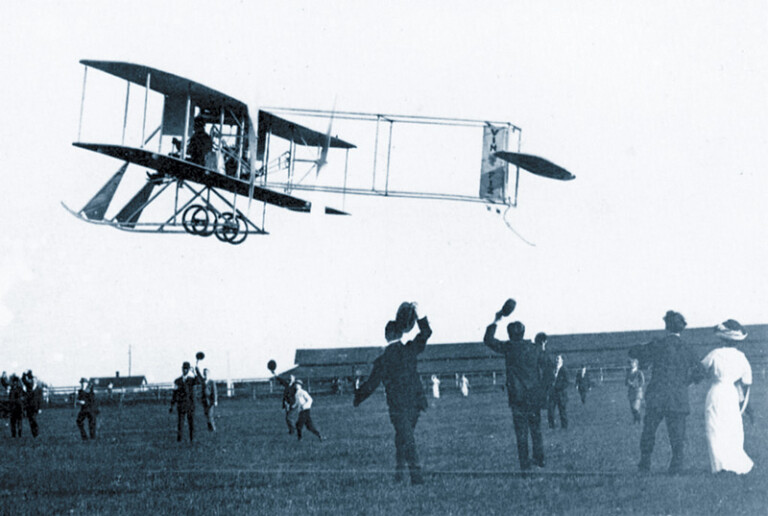
Only 2% of Americans had even seen an “aeroplane” in 1911; so when the Wright biplane was scheduled to take off that September afternoon at the Sheepshead Bay racetrack on Long Island, it was a must-see spectacle for the 2,000 New Yorkers waiting there. However, it wasn’t meant to be just “a short flight around the pea patch.” The pilot, Cal Rodgers, was bold enough to think he could fly coast-to-coast, and qualify for the $50,000 prize offered by Randolph Hearst to anyone who would make the flight in 30 days or less. It was considered to be a publicity stunt by Hearst since few thought it even possible. As Orville Wright told Rodgers: “I’ll sell you one of our ‘aeroplanes’ but they’re not meant for that kind of punishment – you won’t make it as far as Chicago.” While others said “not possible” – Rodgers said “why not?”
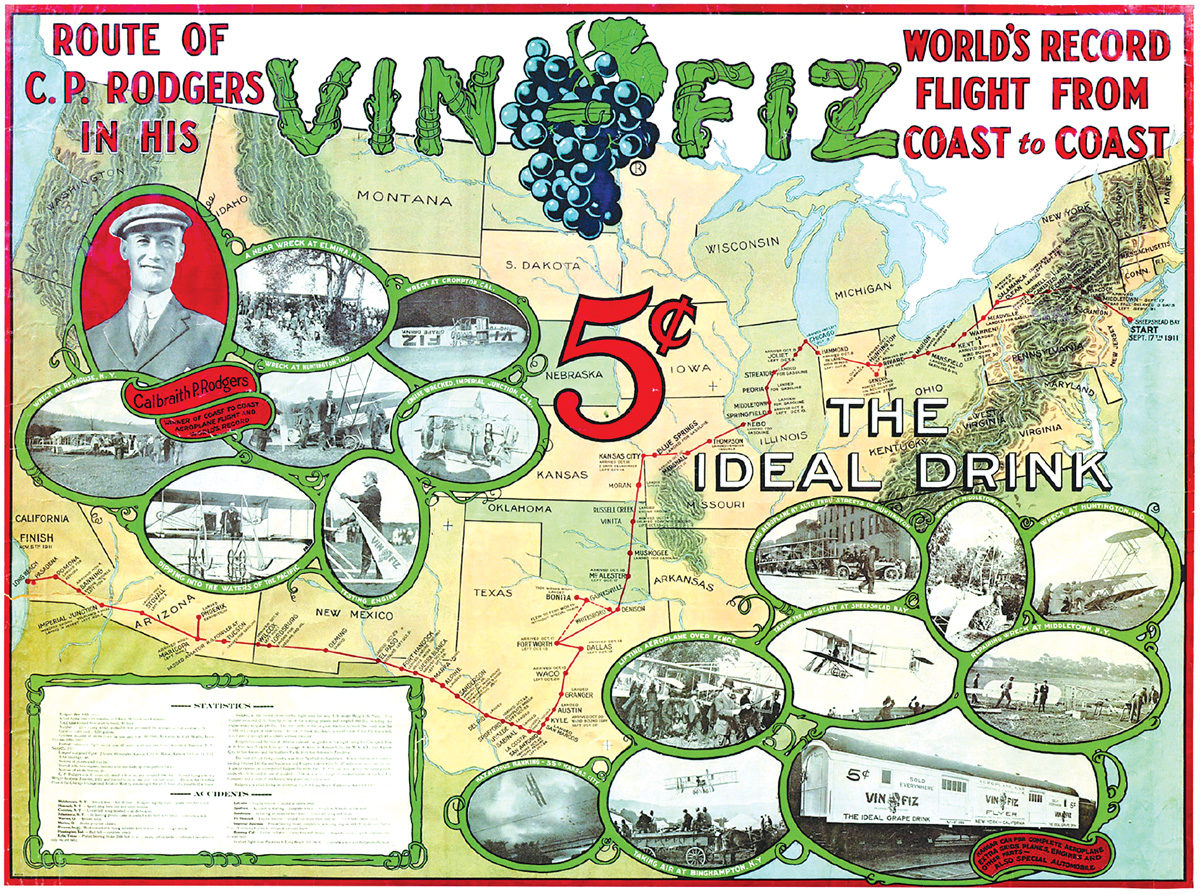
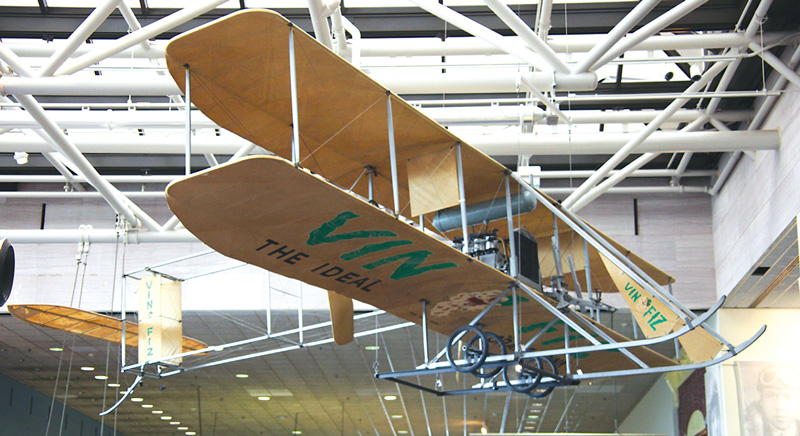
Just 3 months earlier, after only 90 minutes of instruction at the Wright Flying School in Dayton, Rodgers soloed and proclaimed: “A man could become drunk with flying. Everything I’ve done up until now doesn’t matter.” He immediately bought a “Model B” from the Wright brothers and spent that summer barnstorming. At a flying contest in Chicago, Rodgers was awarded first place for most-time- aloft and attracted the attention of J. Ogden Armour, owner of the Vin Fiz Company. Armour wanted to introduce his new Vin Fiz grape soda to the country and agreed to sponsor the flight, after a 20 minute conversation with Rodgers. Armour would pay him $5 for each mile flown east of the Mississippi and $4 west of the river in return for advertising the grape drink. It was the first-ever flying billboard. Painted on the underwing was: “VIN FIZ – THE IDEAL GRAPE DRINK .”
The Vin Fiz Company also provided a train with a private Pullman car for Rodgers and his wife to stay in each night. A second “hangar” car carried several “mechanicians” and was loaded with various spare parts purchased from the Wright brothers to repair the Vin Fiz while en route. In addition, the second car contained a Palmer-Singer automobile that would be used to locate and retrieve the pilot at the end of each day’s flight.
The third rail car was a day coach for photographers and newspaper reporters who filed daily reports on the flight’s progress. Local reporters would climb aboard and travel with the train long enough to get the latest news, then return to their hometown and write stories on the flight that everyone was talking about. Since there were no aerial charts or navigation aids in 1911, Rodgers used the railroad tracks as his “iron compass” and at the same time keeping him close to his support train – The Vin Fiz Special.
The racetrack at Sheepshead Bay was chosen for the starting point because the straightaway provided a smooth “runway” required by the flying machine and the fence kept out gate-crashers not willing to pay $1.50 to see the Wright “aeroplane” up close. Rodgers caught a few hours of restless sleep at the Montague Hotel at 32nd Street and Broadway – known for its “modern porcelain washing and bathroom facilities” – before heading to the racetrack where the anxious crowd had gathered. As he passed through the throng, everyone cheered the “birdman” but for one wag who yelled: “Get a horse!”
After much hand-wringing, hugs and wishes for good luck from his wife and family – and answering endless questions from New York City newspaper reporters – the 6’ 4” Rodgers climbed aboard. Since seat belts had not yet been invented, he settled onto the 12 inch square “drivers seat” which was covered in corduroy so he wouldn’t slide around so easily while airborne. The only onboard “navigation instrument” was an 8” string from his wife’s corset that was attached to a cross wire in front of him to indicate when the aircraft was in a climb, a descent or a bank.
When finished adjusting the magneto and compression controls, he signaled for his crew to pull down on the 2 propellers as he yelled, “Start ‘er up, boys.” The engine noise and exhaust smoke was cheered by the restless audience who were there to witness an historic event. The 10HP Wright engine had 2 speeds – full speed ahead and off – so several wing men held back the shuddering biplane until Rodgers flashed the sign to let “ole Betsy” go. After a short takeoff roll, plane and pilot were aloft on a journey that was to be the media event of 1911. The handsome, charismatic Rodgers would capture the attention of the nation during his state by state, ocean-to-ocean adventure.
Circling back over the crowd at the Sheepshead Bay racetrack, he let loose several hundred leaflets advertising his trans-continental flight and the benefits of drinking Vin Fiz. The cards read: “GREETINGS FROM THE SKY – RODGERS IN THE VIN FIZ FLYER – FROM NEW YORK TO LOS ANGELES FOR HEARST $50,000 OCEAN TO OCEAN FLIGHT – VIN FIZ – THE IDEAL GRAPE DRINK – REFRESHING AND INVIGORATING – 5¢ – SOLD EVERYWHERE.” He continued north, passing over the bandstand at Brooklyn’s Prospect Park where people waved and yelled encouragement. Thousands more on the rooftops and in the streets of Manhattan cheered as Rodgers passed overhead at 200 feet. Children didn’t know what to do – they just gawked. Rodgers was finally on his way and could only guess at what lie ahead.
The first leg of 110 miles from Long Island to Middletown, NY, was uneventful but the next day’s flight was quite another story. On takeoff that morning, Rodgers maneuvered to avoid some telegraph lines but, in so doing, the aircraft clipped a tree and plunged into a chicken coop. Although he was unhurt, several of the chickens weren’t so lucky. After ordering more parts from the Wright brothers and grounded 3 days for repairs, the Wright Vin Fiz was ready again to continue on what was to become an eventful flight.
It was a challenge for Rodgers and his crew to keep spectators away from the aircraft when it landed because, in their enthusiasm, they would paw it and often try to snatch a souvenir. In New Mexico, the gas cap from the aircraft was grabbed as a trophy by a youthful spectator, so a local grocer donated a large potato to take its place. Another “incident” occurred in Ohio where Rodgers had to make an emergency landing in an oat field. Upset, the farmer demanded $25 for crop damage but Rodgers had no cash. Spectators “passed the hat” and collected $4. At locations where he was expected to land, warnings were posted on trees and fence posts. “NOTICE: Owing to the great speed with which a flying machine travels, it continues fully 100 feet after alighting on the ground. If anyone is injured by disregarding this warning, both the Vin Fiz Co. and Mr. Rodgers disclaim all blame for the accident.”
There were other “mishaps” along the way – some amusing – none fatal. After 12 crashes and 70 landings in a dozen different states, Rodgers touched down in California at Long Beach with both ankles in casts and crutches strapped to the side of the battered Wright biplane. The injuries were caused in an earlier crash at Compton. The weary but happy – bruised but not broken – pilot was greeted by 50,000 enthusiastic admirers. As Rodgers later said: “Many said it was foolhardy to attempt such a flight. Foolhardy? Well I hardly think I’m a fool but I do admit there’s no quit in me! I told my guys as long as they kept on repairing the Vin Fiz after each crash, I’d keep on flying. Fix ‘er up boys.”
Although he didn’t complete the flight in the required 30 days to qualify for the $50,000 Hearst prize, the $5 per mile agreement with the Vin Fiz Company came to $23,000 – the equivalent of more than $550,000 today. The 32-year-old Rodgers was a national celebrity and is now enshrined in the National Aviation Hall of Fame at Dayton, Ohio.
The Wright Vin Fiz was restored in 1961 by the Smithsonian Institution in time to celebrate the 50th anniversary of the flight. A limited supply of the original wing fabric preserved from that restoration is available at www.aviationrelics.com along with a signed Certificate of Authenticity from the National Air and Space Museum where the Vin Fiz can be seen today.